Inside Pakistan’s Rehab Centres: NCHR Report Alleges Abuse and Illegal Detentions
Investigation highlights forced admissions, poor oversight and alleged mistreatment of women and vulnerable patients in psychiatric and rehabilitation facilities across Pakistan.

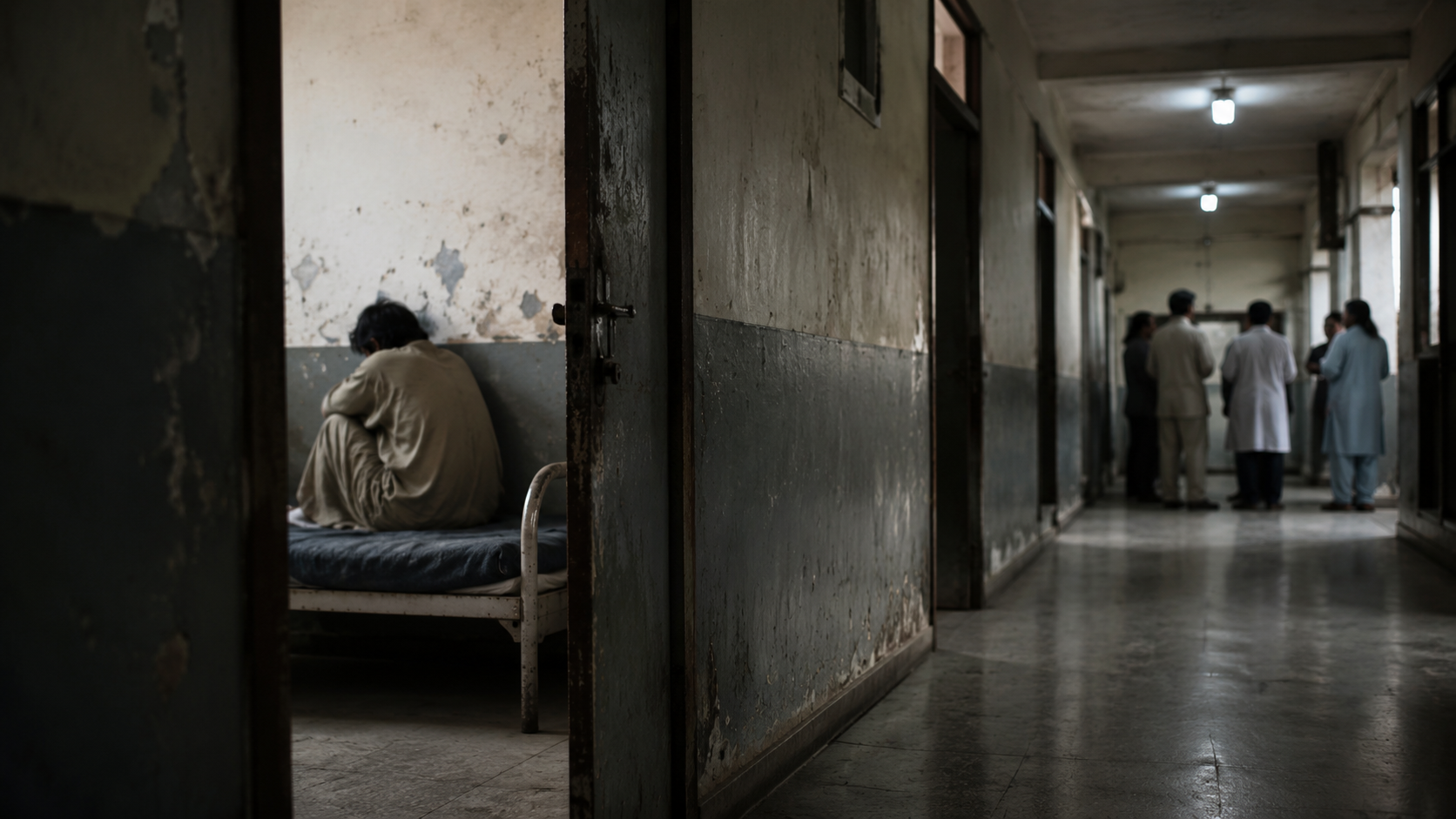

Pakistan’s rehabilitation and psychiatric care system is facing renewed scrutiny after a recent investigation by the National Commission for Human Rights documented widespread allegations of unlawful confinement, involuntary admissions, abuse, and weak regulatory oversight inside rehabilitation facilities across the country.
The report, titled “Caged in Care: Investigating Human Rights Violations in Rehabilitation Centres,” was launched under the Huqooq-e-Pakistan II project with support from the United Nations Development Programme and the European Union. Based on site visits, interviews with former patients, testimonies from families, and discussions with rehabilitation centre management, the investigation presents a troubling picture of institutional practices operating with little accountability.
According to the Commission’s findings, many rehabilitation centres are allegedly functioning more as spaces of confinement than healthcare institutions, where vulnerable individuals, particularly women and minors, are admitted without informed consent, psychiatric assessment, or judicial oversight.
Women allegedly confined after family disputes
The investigation documents several cases in which women were reportedly taken to rehabilitation facilities against their will following domestic conflicts, property disputes or disagreements with family members.
In one case highlighted by the Commission, a practicing lawyer was allegedly confined after a dispute with her brothers over family property. Investigators reportedly found no medical basis for her detention and concluded that the rehabilitation process appeared linked to attempts to remove her from the dispute.

The report states that women were often admitted after resisting forced marriages, asserting personal autonomy or becoming involved in inheritance and property conflicts.“A high-court lawyer abducted as she worked in her home, a young professional pulled from her bed in the dead of night,” the report notes while describing incidents of forced admissions through so-called “involuntary pickups.”
Testimonies describe forced injections and physical restraint
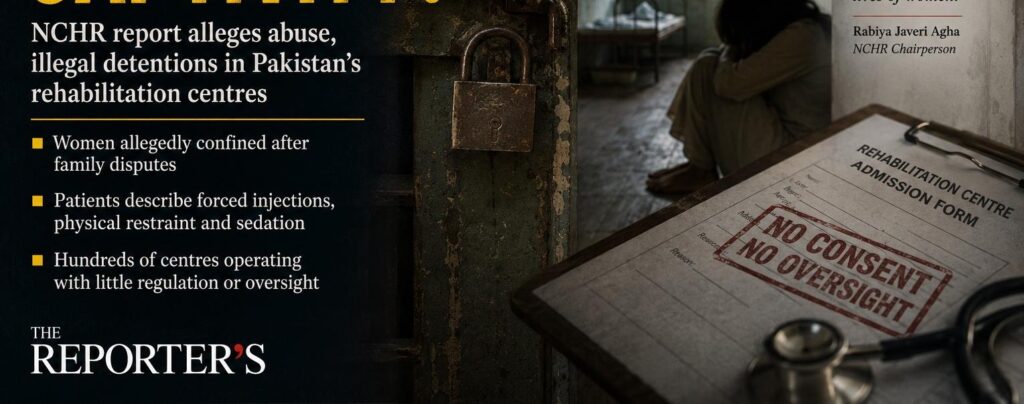
Former patients interviewed by investigators described incidents in which individuals were allegedly physically restrained, sedated and transported to rehabilitation centres without consent.
One woman from Karachi told investigators that after a domestic disagreement, several men entered her home, restrained her and injected her before taking her to a facility.Another woman recalled being forcibly removed from her room following a dispute with her father.“A man climbed on top of me. He grabbed me and injected me,” the report quoted her as saying.
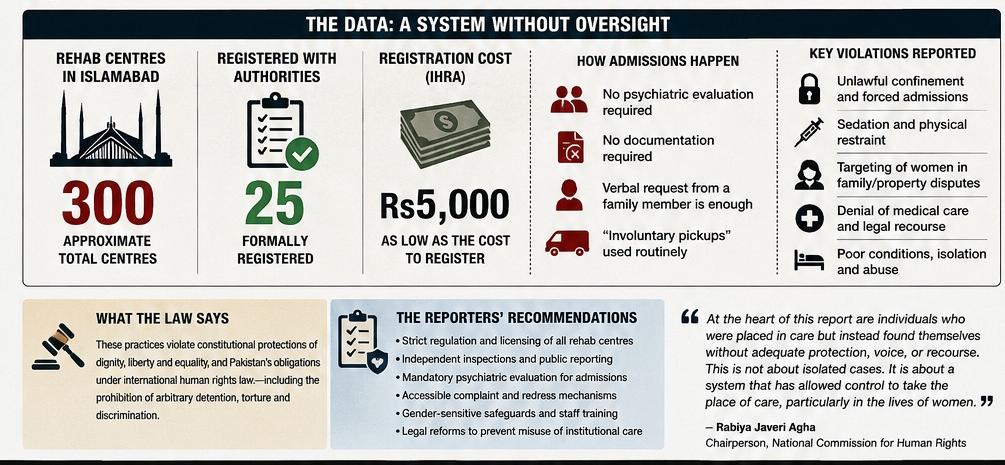
According to the investigation, several rehabilitation centres informed the Commission that admissions could proceed solely on the verbal request of family members, without requiring legal guardianship documents, psychiatric evaluations or court authorisation.
The report also documents statements allegedly made by staff members during the inquiry.“We don’t need any tests or anything, just let us know the address where we should pick the patient up,” one facility representative reportedly told investigators.Another staff member allegedly stated that male employees physically restrained women during admissions when patients resisted.
Poor conditions and lack of medical oversight
The Commission’s investigation further points to overcrowding, poor hygiene, expired medicines and a shortage of qualified psychiatric professionals in several facilities.
Former patients described routines dominated by sedation, isolation or religious instruction rather than evidence-based medical treatment.“We get up at 5 a.m. and spend the whole day praying. There was no treatment for my illness,” one former patient told investigators.
According to the report, many centres lacked proper counselling services, rehabilitation programmes or independent complaint mechanisms for patients.The investigation also alleges that some facilities relied heavily on untrained staff while operating with minimal medical supervision.
Hundreds of centres operating with limited regulation
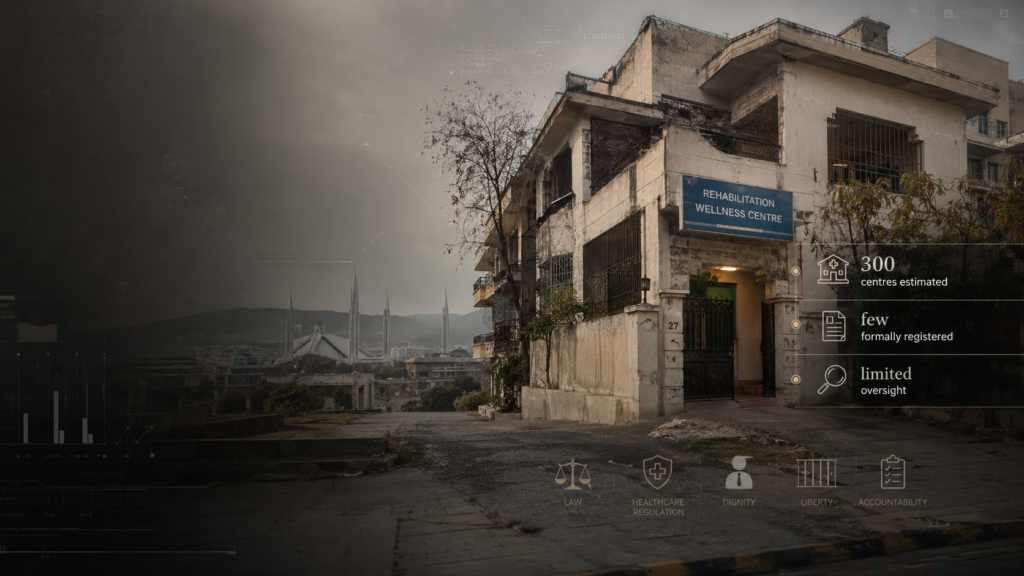
The report estimates that around 300 rehabilitation centres are operating in Islamabad alone, while only a small number are formally registered with the Islamabad Healthcare Regulatory Authority.
Investigators noted that rehabilitation clinics can reportedly be registered for relatively low fees, allowing facilities to operate from converted residential buildings with limited oversight.The report argues that Pakistan’s mental healthcare framework remains fragmented and poorly regulated, with weak implementation of existing laws and limited accountability mechanisms.
According to the Commission, several practices documented during the investigation may violate constitutional protections related to dignity, liberty and equality, as well as Pakistan’s international human rights obligations concerning arbitrary detention and torture.
NCHR calls for urgent reforms
Speaking at the launch event, NCHR Chairperson Rabiya Javeri Agha said the findings reflect deeper structural failures within institutional care systems.“At the heart of this report are individuals who were placed in care but instead found themselves without adequate protection, voice, or recourse,” she said.
“This is not about isolated cases. It is about a system that has allowed control to take the place of care, particularly in the lives of women.”Van Nguyen, speaking at the event, stressed the need for stronger oversight and accountability mechanisms in rehabilitation and psychiatric care institutions.
The report recommends stricter regulation of rehabilitation centres, independent monitoring systems, legal safeguards for involuntary admissions, accessible complaint procedures and stronger psychiatric oversight.It also calls for gender-sensitive protections to ensure rehabilitation facilities cannot be misused to suppress personal autonomy or family dissent under the guise of treatment.
The findings have reignited concerns over the state of mental healthcare regulation in Pakistan and raised broader questions about whether rehabilitation centres meant for treatment and recovery are instead becoming spaces where abuse remains hidden behind closed doors.