Government Advertising Surges as Media Industry Struggles, Parliamentary Records Show
Electronic media ad spending rises from Rs371m to over Rs5bn in five years

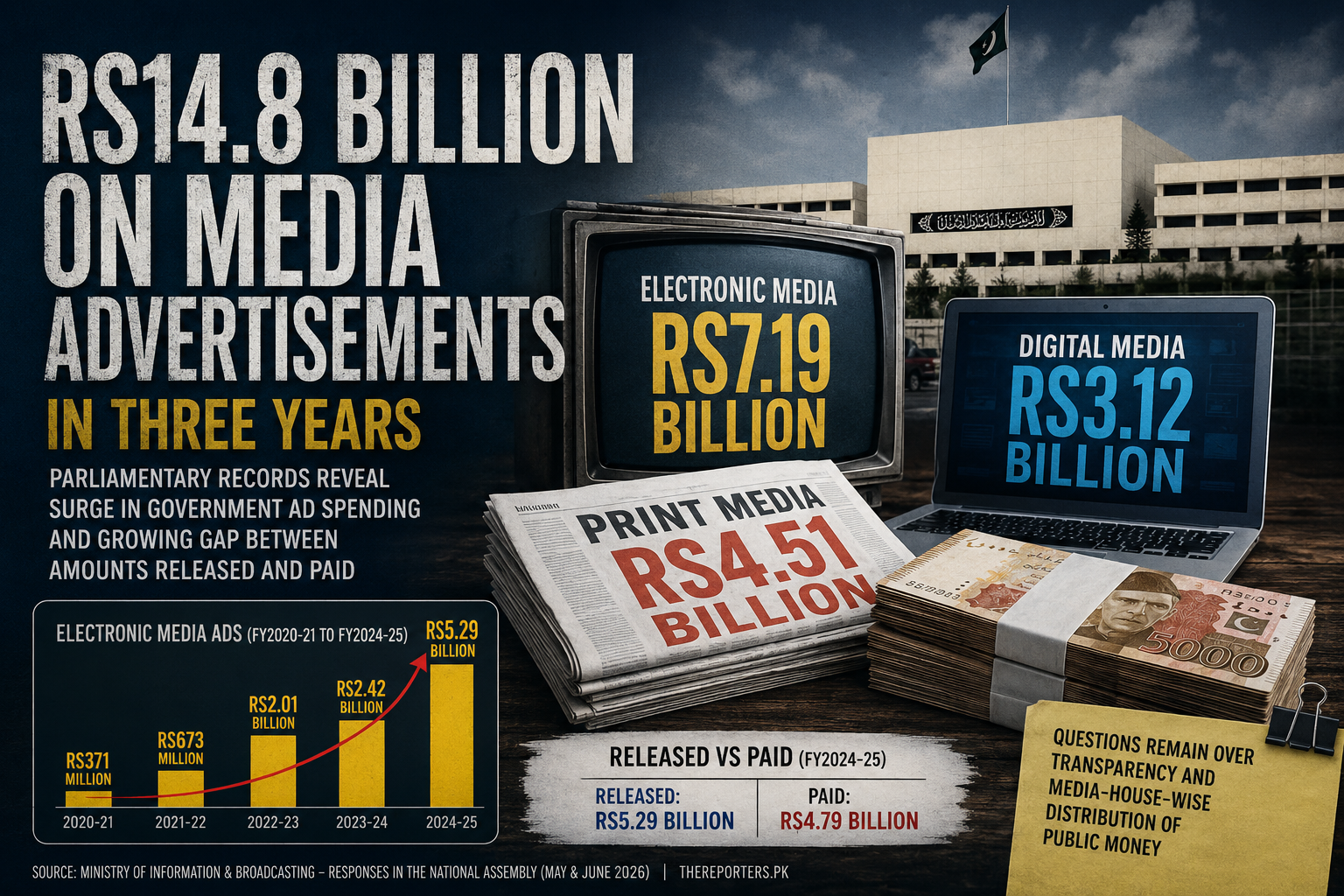

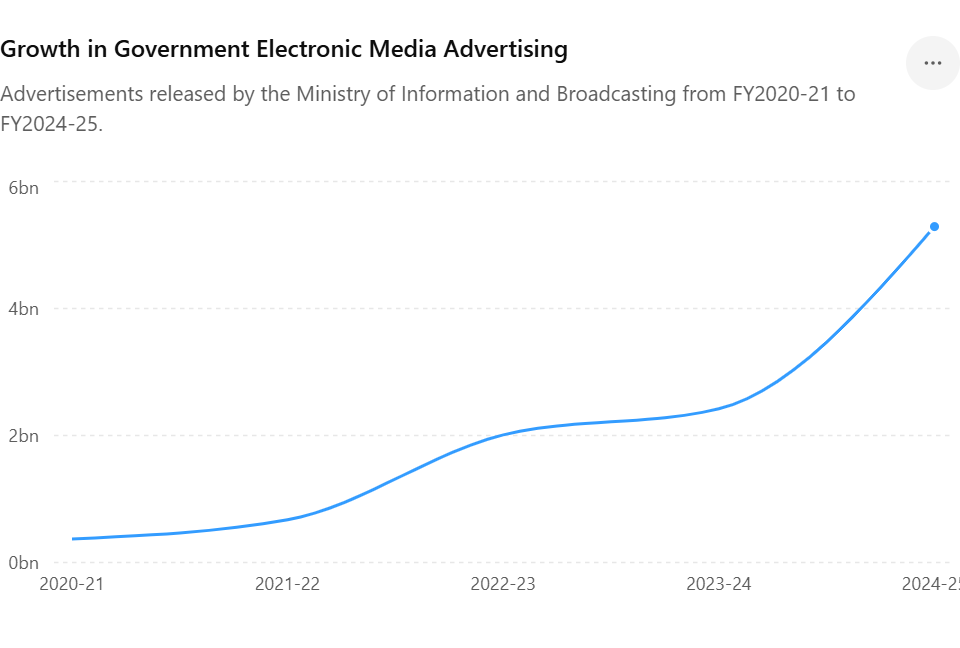
ISLAMABAD: The federal government’s spending on media advertisements has expanded dramatically over the past five years, with official parliamentary records showing that the value of advertisements released to electronic media by the Ministry of Information and Broadcasting (MoIB) increased from Rs370.9 million in 2020-21 to more than Rs5.2 billion in 2024-25.
The figures, disclosed in separate responses submitted by Information Minister Attaullah Tarar to the National Assembly, reveal both the scale of government advertising and the growing role of public funds in Pakistan’s financially strained media industry.The documents show that while billions of rupees have been spent on public information campaigns, there is also a significant distinction between advertisements released by the government and payments actually made to media organisations, highlighting a gap that has received little public attention.
A sharp rise in government advertising
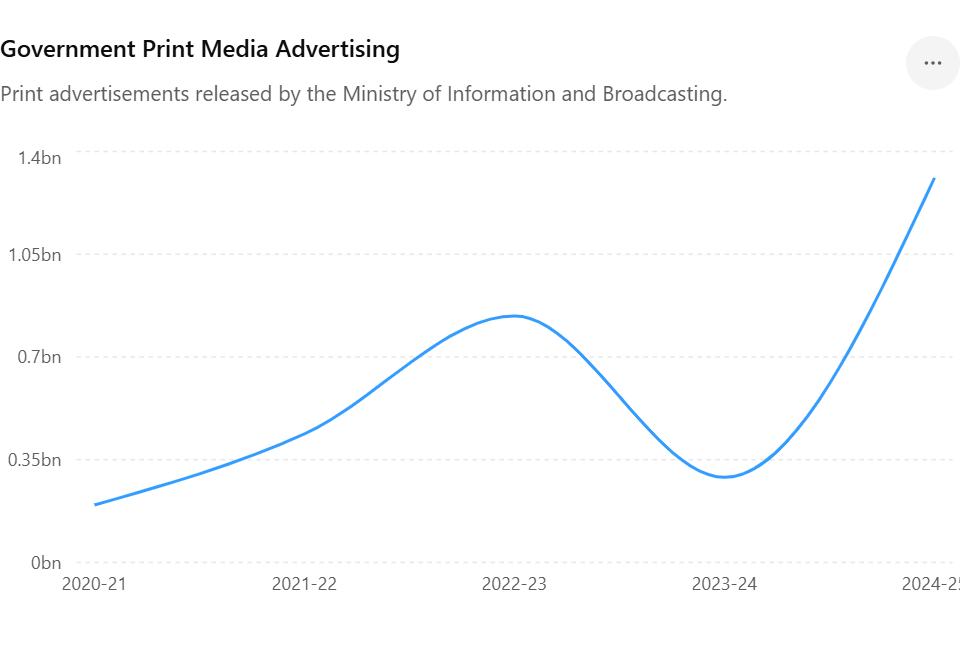
According to parliamentary records, the Ministry of Information and Broadcasting released electronic media advertisements worth Rs370.9m in 2020-21. The figure increased to Rs672.7m in 2021-22, Rs2.01bn in 2022-23, Rs2.42bn in 2023-24 and Rs5.29bn in 2024-25.The growth represents an increase of more than 1,300 per cent in five years.A similar trend can be observed in print media spending. Advertisements released by the ministry rose from Rs195.6m in 2020-21 to Rs1.31bn in 2024-25.
Government records indicate that advertisements were issued across print, electronic and digital platforms to publicise economic reforms, foreign policy initiatives, governance reforms, youth programmes, Kashmir-related campaigns, climate change initiatives, tourism promotion, public safety messages and campaigns linked to national security issues, including Marka-e-Haq, Youm-e-Tashakur and the Pakistan-India standoff.
The ministry maintains that advertisements are issued in accordance with the Federal Government Advertisement Policy 2021 and the Advertisement Guidelines and Procedures 2024, which require allocations to be based on audience reach, circulation data and public benefit rather than political considerations.

Released versus paid
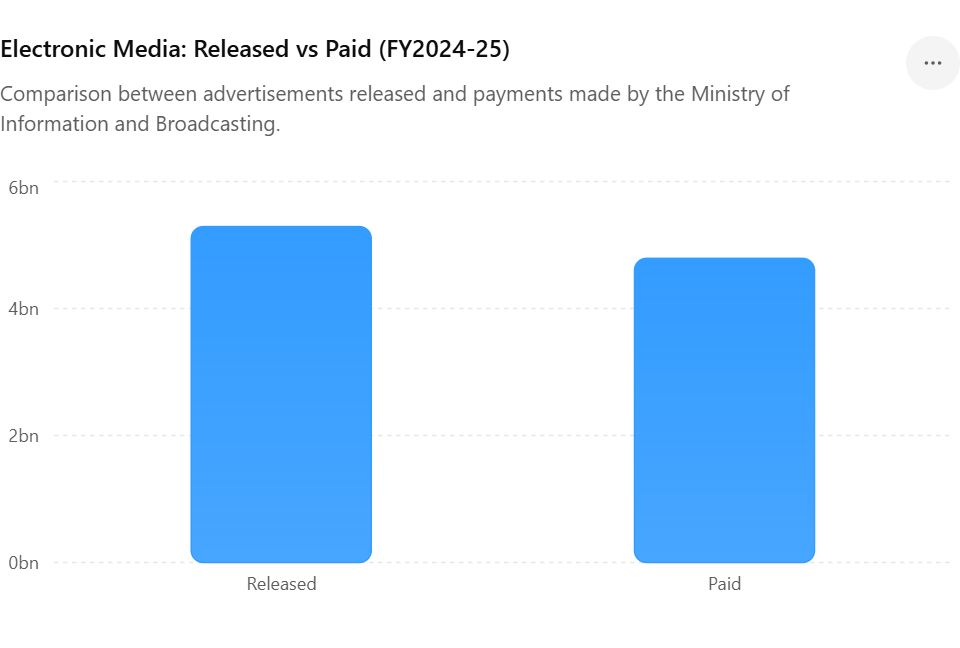
However, a closer examination of parliamentary records reveals that advertisements released and payments made do not always correspond.For example, during 2024-25, the Ministry of Information and Broadcasting reported releasing electronic media advertisements worth Rs5.29bn. Yet the amount actually paid during the same year stood at Rs4.79bn.Likewise, print advertisements worth Rs1.31bn were released, while payments amounted to Rs428.4m.
Government officials explain that payment figures often differ from release figures because media organisations are paid after campaigns are completed and verified, while some payments may relate to liabilities from previous years.The ministry has repeatedly stated in parliamentary replies that outstanding liabilities are cleared regularly to enable media houses to pay salaries and meet operational expenses.
The distinction becomes even more significant when viewed alongside another parliamentary response submitted in June 2026, which reported cumulative payments rather than released advertisements. While many figures correspond closely, some expenditure categories differ substantially, suggesting that different datasets are being used to track commitments and actual disbursements.
Nearly Rs15bn paid across three media sectors
In another response to parliament, the ministry disclosed that from fiscal year 2022-23 through December 2025, a total of Rs14.82bn was disbursed across print, electronic and digital media.Electronic media received the largest share at Rs7.19bn, followed by print media at Rs4.51bn and digital media at Rs3.12bn.
The ministry argued that these expenditures were undertaken to fulfil a constitutional and democratic obligation to inform citizens about government policies, public services and national initiatives.A substantial portion of government advertising, according to the official response, was devoted to public welfare campaigns such as polio eradication, population planning, pollution control and public safety awareness.
Government cites media industry’s financial crisis
One of the most striking acknowledgements in the parliamentary record is the government’s recognition of the financial difficulties facing Pakistan’s media sector.The ministry stated that the media industry, particularly the print sector, is facing a severe crisis and requires financial support to sustain operations and pay salaries to media workers.
As a result, the government says it has continued supporting national and regional media outlets through advertisement campaigns aimed at reaching audiences across the country.The statement is likely to reignite debate about the extent to which Pakistan’s media organisations have become dependent on government advertising revenue at a time when private-sector advertising growth has slowed and several media outlets face economic challenges.
Supplementary grants and audit concerns
The documents also reveal a sharp increase in the budget of the Press Information Department (PID), the government’s principal advertising and communication arm.PID’s original budget allocation of Rs728m in 2022-23 rose to nearly Rs3.7bn after supplementary grants and adjustments. By 2024-25, the department’s final budget had exceeded Rs5.2bn.
The ministry also acknowledged an audit objection involving the use of a supplementary grant worth Rs1.79bn by PID during 2022-23. The matter was referred back for further verification and discussion after review by the Public Accounts Committee.The final audit report for 2023-24 has not yet been received, while the audit for 2024-25 remains pending.
Limited hiring, expanded communication spending
While media spending expanded significantly, the ministry reported relatively limited hiring within institutions operating under its control.No regular recruitment was carried out at the Press Information Department during the current government’s tenure, although 32 individuals were appointed on contract under the Counter Violent Extremism Project.The Associated Press of Pakistan made 15 contractual appointments, while Pakistan Broadcasting Corporation, the Press Council of Pakistan and the Central Board of Film Censors collectively hired fewer than a dozen employees.
Questions remain
Although the government has provided aggregate figures for media spending, one major piece of information remains unavailable in the public domain: the names of media organisations that received the largest share of advertisement funds.The parliamentary responses repeatedly refer to allocations based on ratings, circulation and audience reach, but detailed media-house-wise disbursement data was not included in the documents made public.
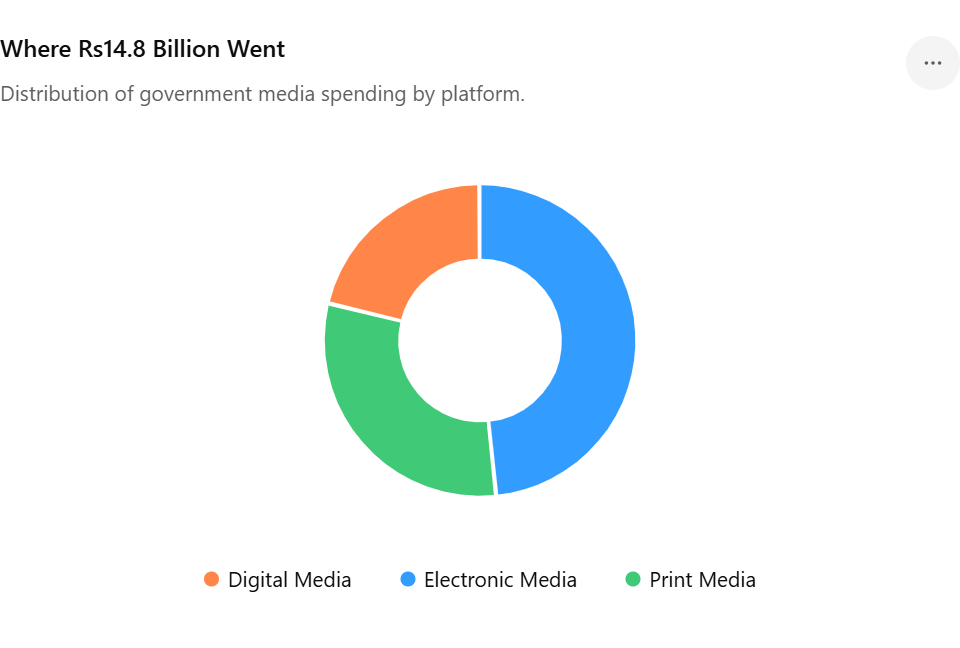
Distribution of government media spending by platform.
As government advertising reaches record levels and media organisations continue to grapple with financial pressures, the relationship between public spending and media sustainability is likely to remain an important subject of scrutiny.For now, parliamentary records show that government advertising has become one of the largest streams of public communication expenditure in recent years and one whose scale continues to grow.