Islamabad M-Tag System Generates Over PKR 121 Million Amid Renewed Questions on Digital Vehicle Monitoring
Parliamentary data shows nearly half a million vehicles registered under FWO-run system as concerns resurface over durability, transparency, and past E-Tag controversies affecting public trust in digital surveillance initiatives.

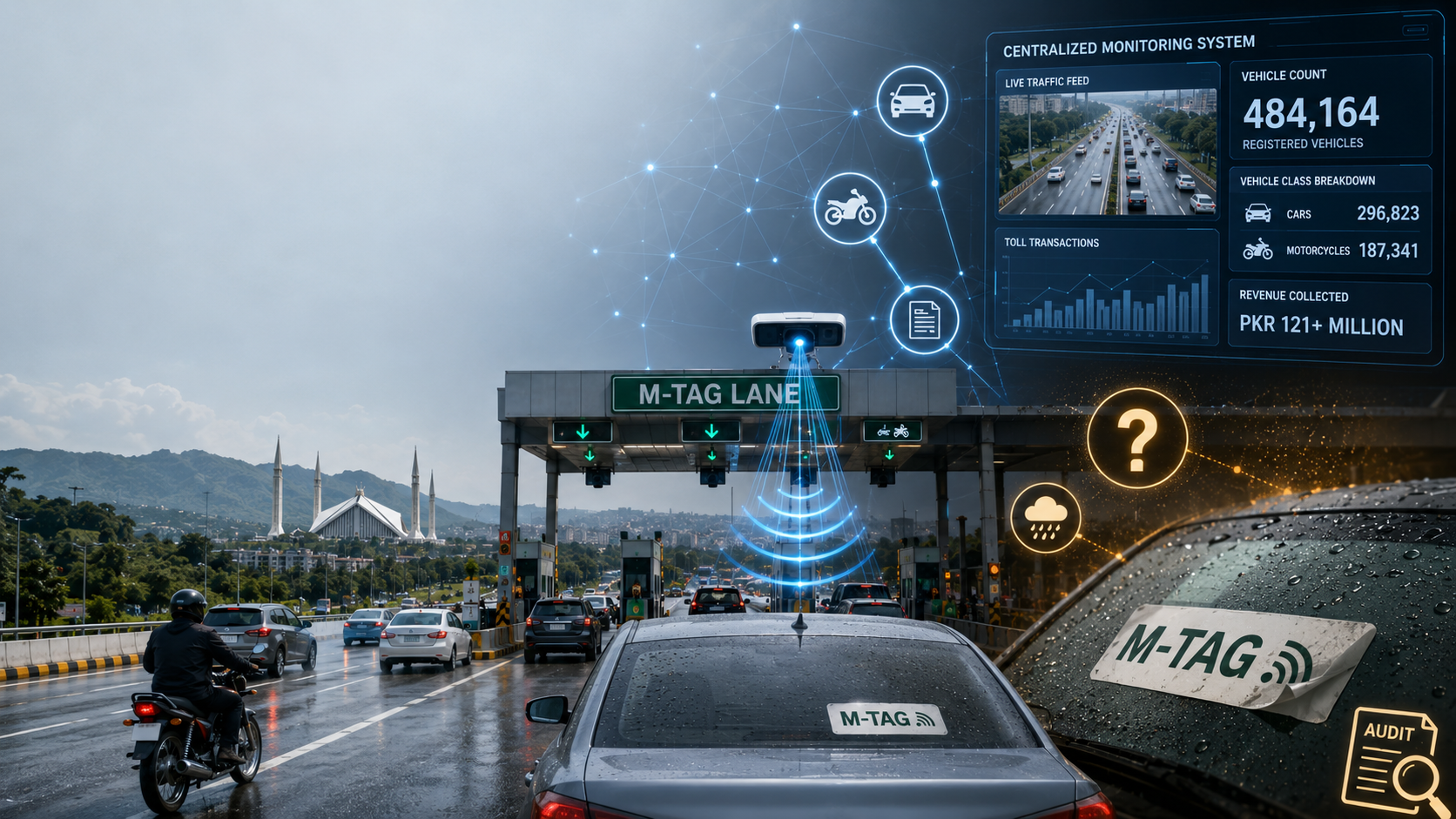

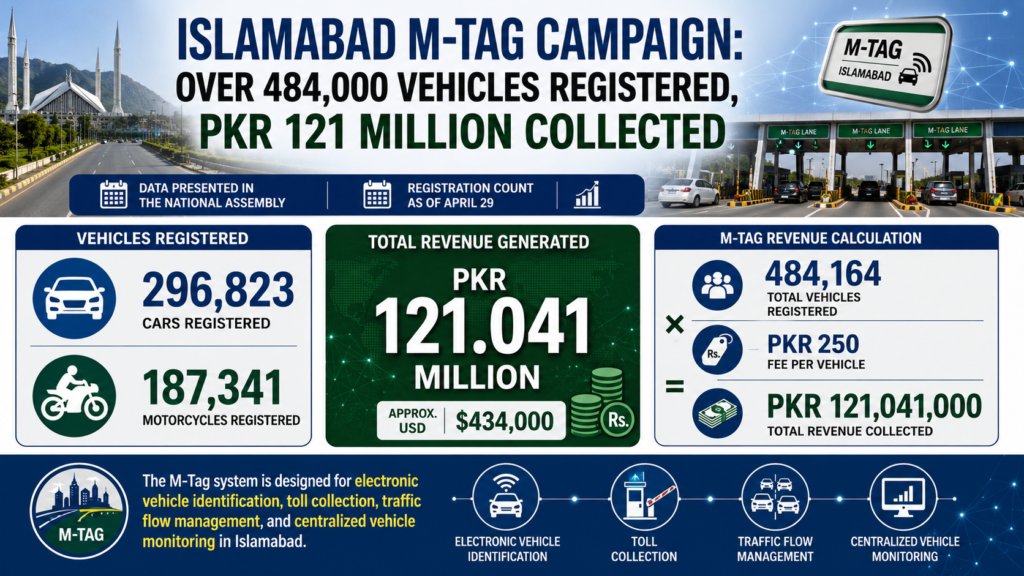
Pakistan’s Frontier Works Organization (FWO) has collected more than PKR 121 million (approximately $434,000) through Islamabad’s M-Tag registration campaign, according to figures presented in the National Assembly – a development that highlights the rapid expansion of digital vehicle monitoring systems in the federal capital, but also revives long-standing public questions about their effectiveness, durability, and real-world impact on security and governance.
State Minister for Interior Talal Chaudhry informed lawmakers that a total of 484,164 vehicles had been registered under the system by April 29, including both cars and motorcycles as part of Islamabad’s digital vehicle identification drive.
The breakdown shared in Parliament shows that 296,823 cars and 187,341 motorcycles were registered under the campaign, with each vehicle charged PKR 250 for issuance of an M-Tag. On this basis, the initiative generated approximately PKR 121,041,000 in revenue. Officials describe the system as part of a broader effort to modernize toll management and vehicle monitoring in the federal capital through digital identification tools.
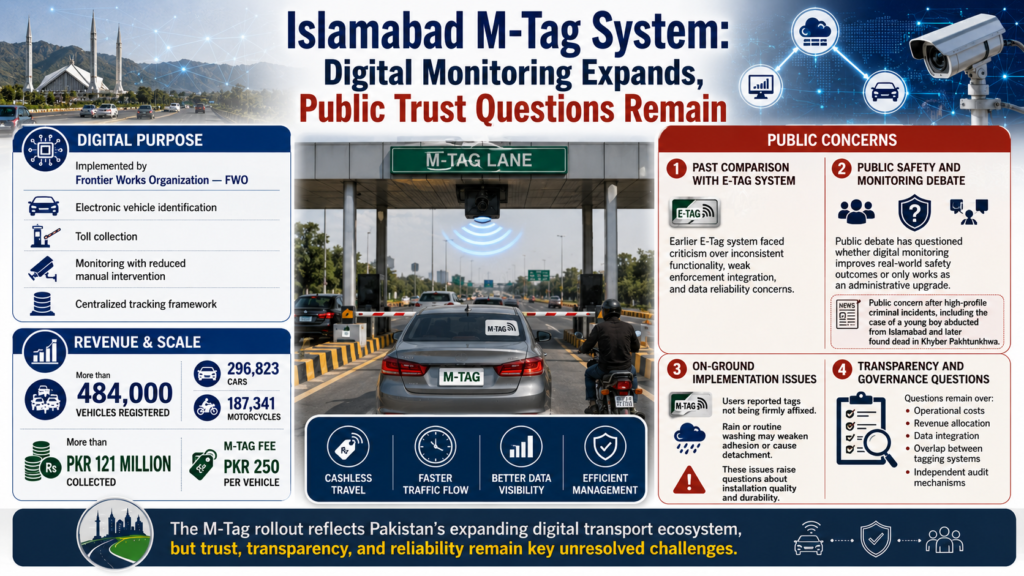
The Islamabad M-Tag system is designed as an electronic vehicle identification mechanism used for toll collection and monitoring purposes. It is intended to streamline traffic flow, reduce manual intervention at toll points, and integrate vehicle data into a centralized tracking framework. However, even as authorities highlight its administrative efficiency, the system is once again drawing comparisons with earlier digital initiatives, particularly the controversial E-Tag system, which was also introduced for electronic tolling and vehicle monitoring.


Concerns over past systems and public trust in digital monitoring
The E-Tag system, introduced as part of earlier efforts to digitize toll operations, faced persistent criticism from users over issues including inconsistent functionality, weak enforcement integration, and concerns about data reliability. Over time, public debate around such systems expanded beyond technical shortcomings, with citizens questioning whether digital monitoring tools were genuinely improving safety outcomes on roads or merely functioning as administrative upgrades without meaningful enforcement impact.
These concerns have resurfaced with the M-Tag rollout, particularly in the context of broader public safety anxieties linked to gaps in surveillance and response systems. In public discourse, high-profile criminal incidents have often intensified scrutiny of monitoring infrastructure, including the widely discussed case of a young boy who was abducted from Islamabad and later found dead in Khyber Pakhtunkhwa. The incident triggered national concern and renewed debate about the effectiveness of tracking and response mechanisms in preventing or addressing serious crimes.
While authorities have not linked such cases directly to failures in digital tagging systems, these events have contributed to a growing perception gap between the promise of surveillance technologies and their practical outcomes in real-world situations.
On-ground implementation issues and questions over system reliability
Alongside historical concerns, users of the newly implemented M-Tag system have raised practical issues related to its physical durability and installation quality. Motorists in Islamabad report that tags are often not firmly affixed, with some claiming that exposure to rain or routine washing can weaken adhesion or cause detachment. For daily commuters, these issues create operational inconvenience and raise questions about quality control standards in a system handling nearly half a million registered vehicles.
At the institutional level, the Frontier Works Organization plays a central role in implementing the M-Tag system. Known primarily for its engineering and infrastructure work — including motorways, tunnels, dams, and strategic construction projects — FWO has in recent years expanded into toll management and digital infrastructure initiatives. Its involvement in the M-Tag campaign reflects a broader trend in Pakistan’s transport governance model, where infrastructure-linked institutions are increasingly tasked with executing digital monitoring systems.
The expansion of such systems, however, has also sparked policy-level questions about overlap between different tagging mechanisms, integration of data across federal and provincial frameworks, and transparency in revenue utilization. While PKR 121 million has been collected through the M-Tag campaign alone, details regarding operational costs, revenue allocation, and independent audit mechanisms have not been fully disclosed in parliamentary proceedings.
As Pakistan continues to expand its digital transport ecosystem, the M-Tag system now sits at the intersection of modernization efforts and recurring public concerns – reflecting both the scale of technological adoption and the unresolved challenges of trust, transparency, and system reliability in practice.