Govt Ad Spending on Print and Electronic Media Hits Rs9.52bn in 2024-25


The latest controversy involving senior journalist Matiullah Jan has once again highlighted the growing pressure on Pakistan’s media industry, where editorial independence, financial survival, and government influence appear increasingly intertwined.
According to Matiullah Jan, the issue began when he arranged a private dinner in Islamabad for foreign journalists visiting Pakistan to cover the ongoing Iran-US peace talks. The gathering, he said, was intended to give international reporters an opportunity to interact informally with Pakistani journalists and better understand the state of media freedom in the country.
Jan alleged that officials from the Ministry of Information and Broadcasting repeatedly approached him and attempted to convince him to cancel the dinner because the ministry had arranged its own “cultural night” for the same foreign journalists on the same evening. The following day, Jan said, he was taken off air from his program on Neo News after a video clip circulated online in which he spoke about press freedom in Pakistan and referred to controversial detentions involving journalists and activists, including Imran Riaz Khan and Haidar Ali Chatha.
The incident quickly became part of a wider debate about how political pressure and financial dependency increasingly shape newsroom decisions in Pakistan.
“A government that restricts media freedom ultimately risks losing both credibility and its connection with the people,” said Tanvir Shahzad. “In Pakistan, the shrinking space for independent journalism has replaced honest feedback with managed narratives, distancing the state from ground realities. Media freedom will return only when power chooses accountability over control, and truth over narrative management.”

The controversy emerged just days after another major crisis in Pakistan’s television industry. More than 170 employees of Suno News were reportedly terminated without prior notice, while several employees alleged they had not received salaries for previous months.
The dismissals triggered protests from the Parliamentary Reporters Association, whose members boycotted National Assembly proceedings in protest against the layoffs and unpaid dues. The pressure eventually forced Information Minister Attaullah Tarar to visit the press gallery, where he announced that government advertisements for Suno News would be suspended until the issue was resolved.
However, the situation took another turn almost immediately. The following day, Suno News management reportedly visited the office of the information minister alongside prominent television anchor Ajmal Jami. Soon afterwards, according to journalists familiar with the matter, the channel’s government advertisements were restored, while concerns regarding dismissed employees and unpaid salaries remained unresolved.
For many within the industry, the episode reinforced the belief that state advertisements have become one of the government’s most effective tools for influencing media organizations.
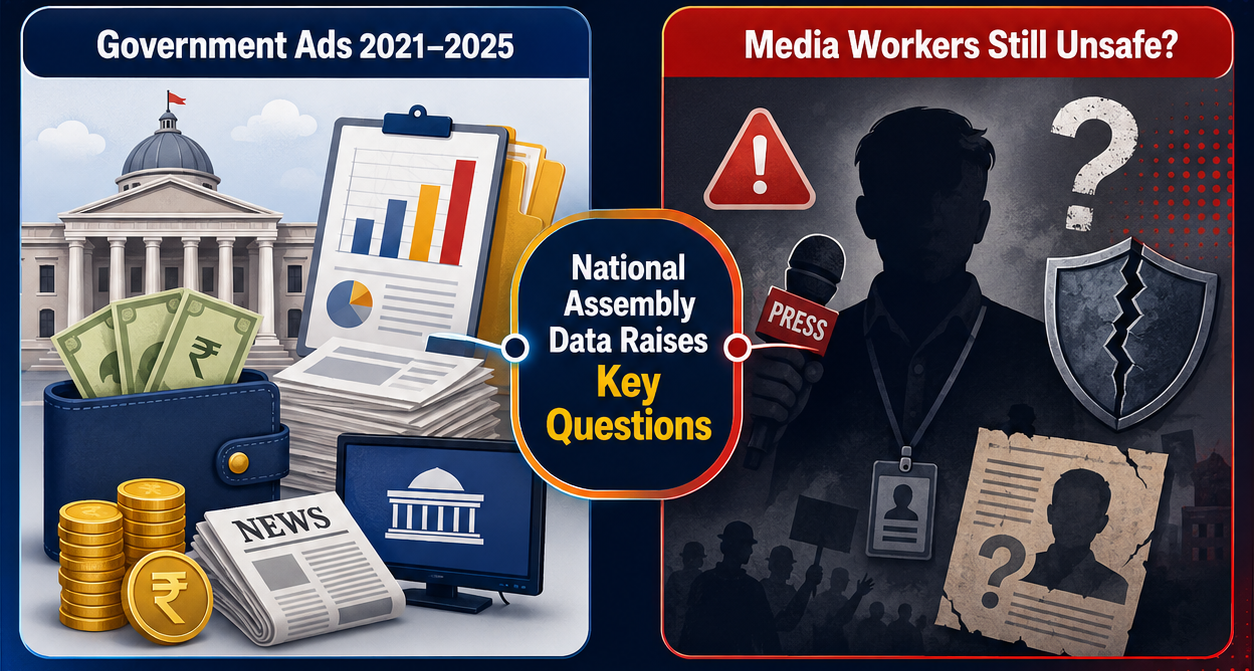
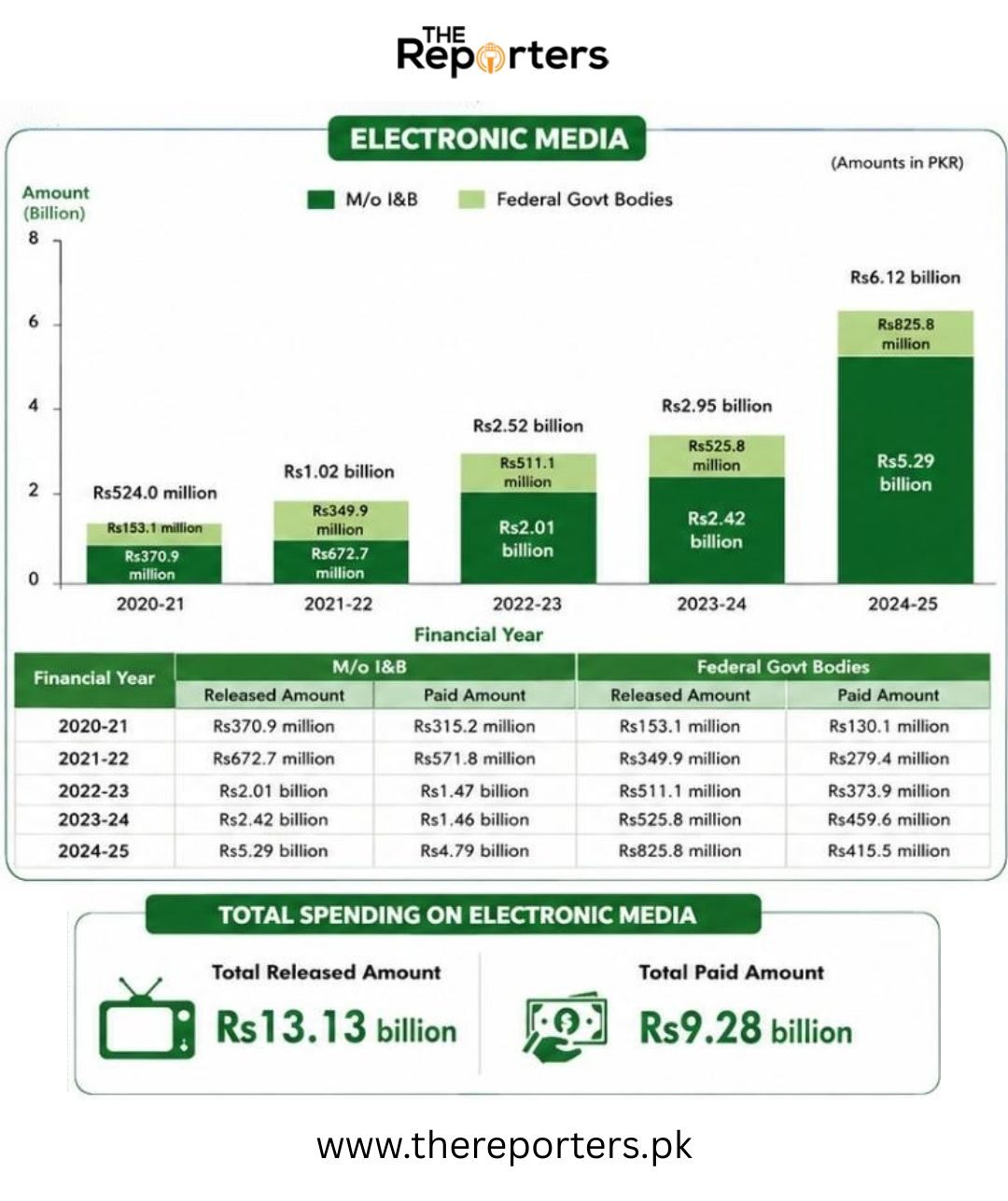
Official figures presented in the National Assembly illustrate why these advertisements are so important for financially struggling media houses.
According to documents submitted by the Ministry of Information and Broadcasting in response to a parliamentary question, the federal government released and paid billions of rupees in advertisements to print and electronic media outlets over the past five financial years.
The ministry stated that all advertisements were issued under the Federal Government Advertisement Policy 2021, amended in 2022, along with the Advertisement Policy Guidelines and Procedures 2024. According to the official response, the advertisements were aimed at informing citizens about public policies, economic reforms, governance initiatives, health campaigns, national security, tourism, climate change, Kashmir, cyber security, youth empowerment, and public welfare initiatives including polio eradication and population planning.
The ministry also stated that advertisement allocations are based on “reach, audience, and measurable public benefit,” while rates are determined through the Rate Fixation Committee (RFC) after consultation with the Pakistan Broadcasters Association and the All Pakistan Newspapers Society.
But despite the official justification, the figures have intensified concerns about the relationship between state spending and editorial independence.
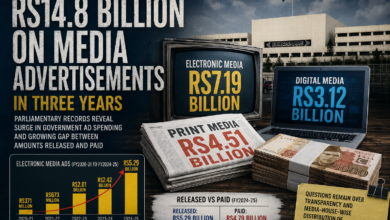
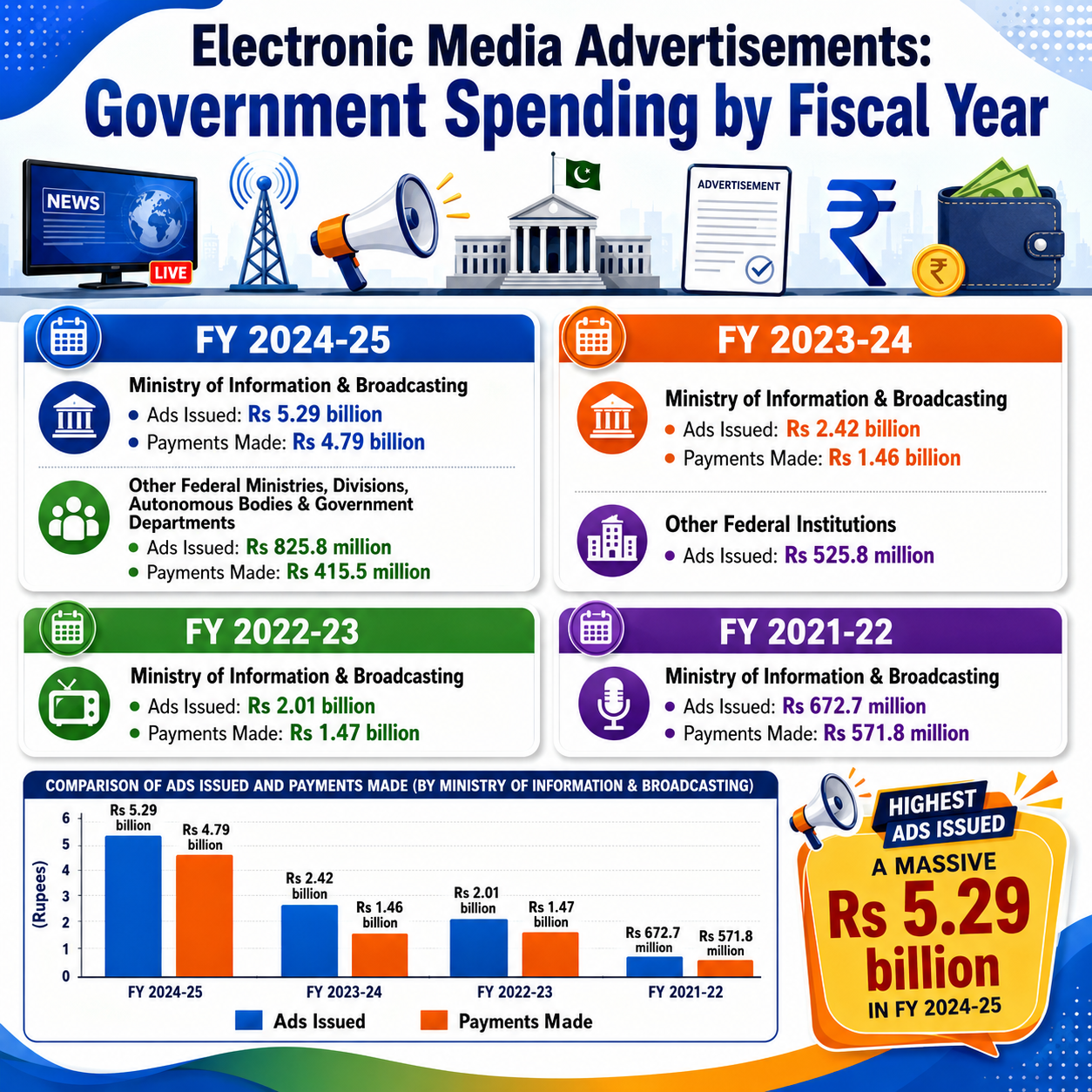
For electronic media alone, the Ministry of Information and Broadcasting released advertisements worth Rs5.29 billion during the 2024-25 financial year, while payments of Rs4.79 billion were made. In the same year, federal ministries, autonomous bodies, and other state institutions separately released electronic media advertisements worth Rs825.8 million, with payments amounting to Rs415.5 million.
In comparison, during 2023-24, the ministry released Rs2.42 billion in electronic media advertisements and paid Rs1.46 billion, while other federal entities issued advertisements worth Rs525.8 million.
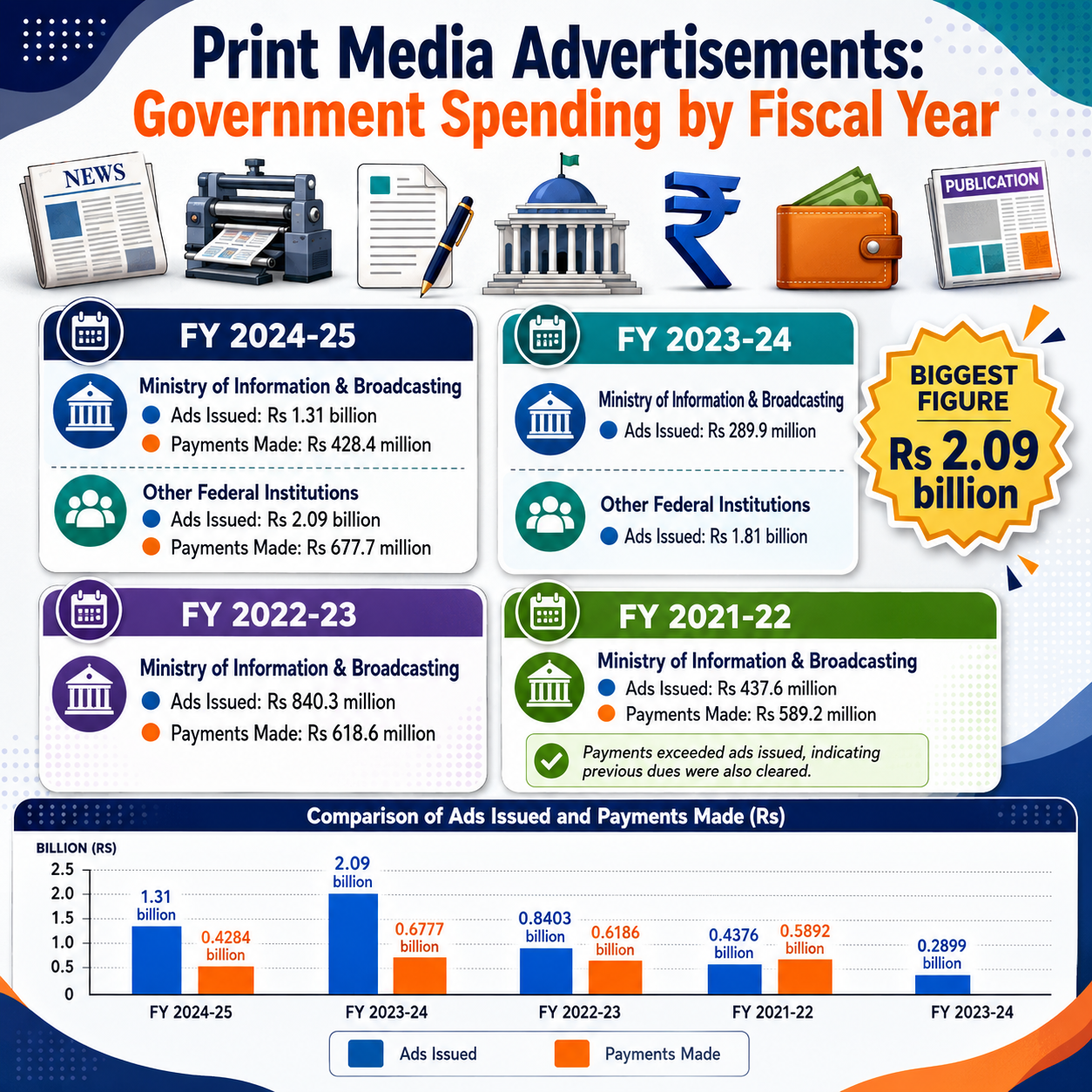
The figures also reveal major expenditure on print media. During 2024-25, the Ministry of Information released print advertisements worth Rs1.31 billion and paid Rs428.4 million, while federal ministries and government bodies separately released advertisements worth Rs2.09 billion and paid Rs677.7 million.
Over five years, government spending on print and electronic media advertisements reached tens of billions of rupees.
Yet media workers across Pakistan continue to report delayed salaries, forced downsizing, layoffs, and deteriorating working conditions.
The crisis has affected even some of Pakistan’s oldest and most established media institutions. Dawn Media Group shut down its Urdu digital platform amid financial constraints and declining advertisement revenues, resulting in layoffs across the newsroom. Similar downsizing measures have been reported at several television channels, newspapers, and digital outlets, including within Jang Group and regional media organizations.
Senior journalist Asma Shirazi said independent journalism in Pakistan is facing pressure from multiple directions at the same time.
“Journalists and independent voices continue to face pressure, while extreme polarization undermines objectivity,” she said. “Alongside state and political influence, misinformation, propaganda, and AI-generated content are further restricting free expression. Recent laws and actions against journalists reflect a persistent pattern of challenges to press freedom in the country.”
Journalist unions and international media organizations have repeatedly warned about the worsening conditions for media workers. Pakistan Federal Union of Journalists and Rawalpindi Islamabad Union of Journalists have staged multiple protests over unpaid salaries and dismissals, while the International Federation of Journalists has urged Pakistan to ensure stronger labor protections and guarantees for press freedom.
Matiullah Jan described the current period as one of the darkest phases for journalism in the country.
“Freedom of expression reinforces the right to know and vice versa. This is the king of all rights without which there is no kingdom of humanity,” he said. “Humanity can only survive where people speak freely and come to a conclusion and a decision which everyone owns and follows.”
“Pakistan is passing through the dark age of press freedom where citizens are punished and persecuted through draconian laws, false cases, unfair trial and unjust convictions,” he added. “Press freedom and free speech has been let down by the timid politicians of today. They know everything and yet pretend to know nothing. They look at the media as their enemy and find friends among the powers to be.”
As Pakistan’s media industry faces financial instability, mass layoffs, editorial pressure, and increasing dependence on state advertising, journalists warn that the country’s press is moving toward a model where survival depends less on independent reporting and more on maintaining favorable relations with those in power.