From Controversial Statistics to Journalist Investigations – How NCCIA’s Senate Briefing Sparked a National Debate


ISLAMABAD: A fresh set of official documents submitted by the National Cyber Crime Investigation Agency (NCCIA) to the Senate Standing Committee on Information and Broadcasting, obtained exclusively by The Reporters, has shed new light on one of the most debated parliamentary briefings on digital governance in recent months.
The documents, presented before the committee after lawmakers sought clarification, explain the origin of the agency’s controversial claim that social media companies comply with 83.64 percent of Pakistan’s legal requests. They also disclose fresh details about an inquiry against Daily Nai Baat Executive Editor Toufeeq Butt, updates on the transfer of PECA cases to NCCIA, and the agency’s interaction with global social media platforms.
However, despite providing a detailed explanation of one controversial statistic, the documents remain silent on another claim that triggered widespread criticism earlier this year—the assertion that 20 percent of social media accounts operating in Pakistan are fake.
How the controversy began
The debate began on 6 May 2026, when NCCIA officials appeared before a Sub-Committee of the Senate Standing Committee on Information and Broadcasting, chaired by Senator Sarmad Ali, to brief lawmakers on Pakistan’s cybercrime landscape.

During the presentation, the agency informed senators that Pakistan had approximately 140 million internet users, that nearly 20 percent of social media accounts were fake, and that social media companies responded to approximately 83 percent of Pakistan’s legal requests, compared with 74.7 percent in India’s case. The agency also informed lawmakers that it had received around 154,000 cybercrime complaints during the previous year.
The figures immediately attracted attention because they were presented as official statistics before Parliament and carried significant implications for digital governance, online safety and government interaction with global technology companies.
Questions raised over NCCIA’s figures
The figures soon came under public scrutiny.
On 15 May 2026, The News International published a report questioning the statistics after speaking with digital rights experts and senior NCCIA officials.
The report highlighted two major concerns.
The first related to NCCIA’s claim that 20 percent of social media accounts in Pakistan are fake. Digital rights experts questioned the basis of the figure, noting that neither the Senate briefing nor any publicly available government document explained the methodology used to arrive at the estimate.
According to The News, even a senior NCCIA official admitted he did not know how the figure had been calculated. The official reportedly acknowledged there was no recognised mechanism capable of accurately determining how many social media accounts in Pakistan were genuine or fake.
The second controversy surrounded NCCIA’s claim that social media companies responded to 83 percent of Pakistan’s legal requests.
Digital rights experts argued that the statistic was potentially misleading because a company’s response to a legal request is not the same as providing user data. Technology companies may acknowledge requests, seek additional documentation, reject requests altogether or provide only limited subscriber information. Therefore, experts argued, presenting the figure without explaining its legal meaning could create an inaccurate public impression regarding government access to users’ private information.
The controversy eventually reached Parliament, prompting members of the Senate Standing Committee on Information and Broadcasting to seek a detailed explanation from NCCIA.
TheReporters.pk
Fresh clarification submitted to Senate committee
Documents now available with The Reporters show that NCCIA has submitted a comprehensive written response to the committee.
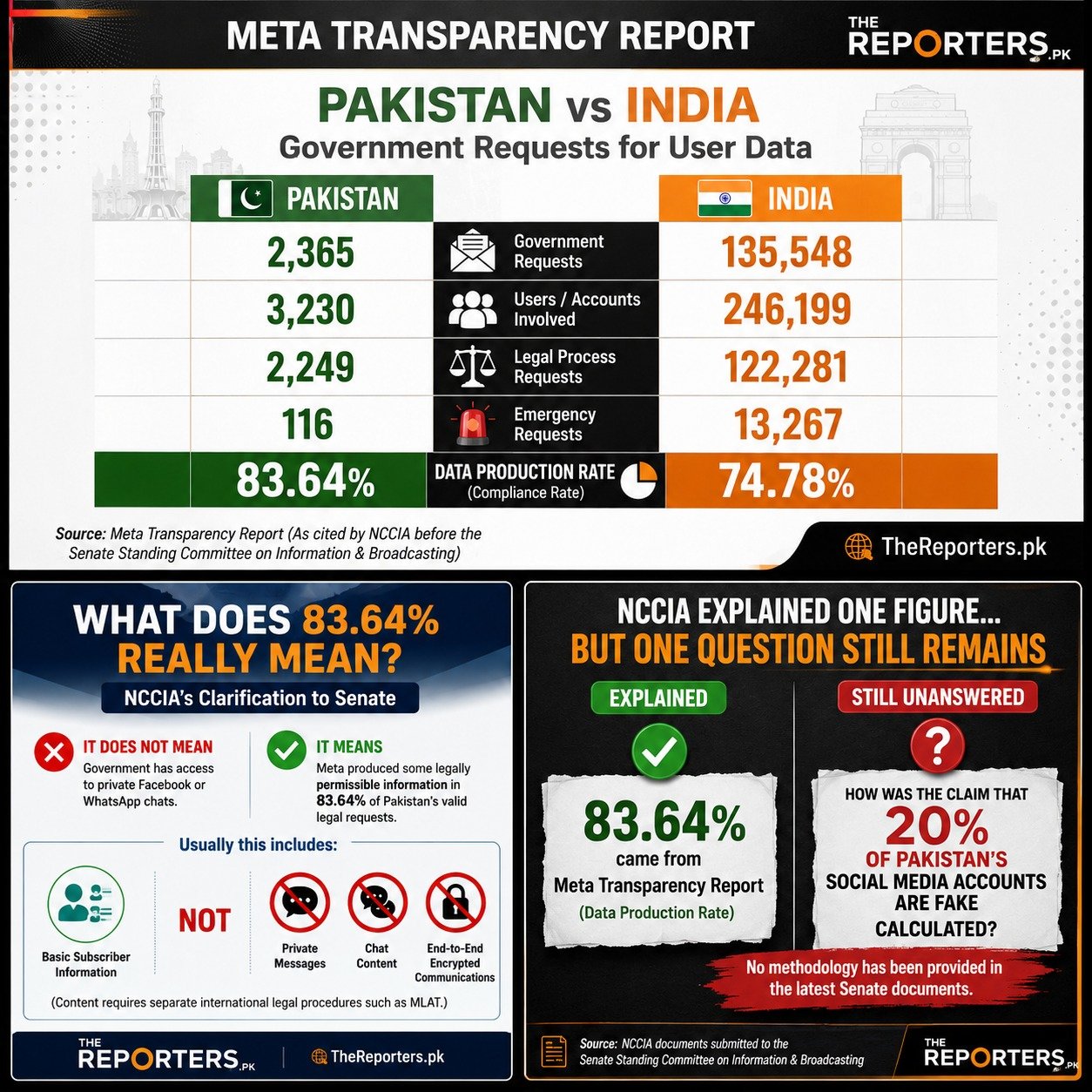
In the new submission, the agency explains that the widely debated 83.64 percent figure was not generated by NCCIA, but was taken directly from Meta’s official Transparency Report.
According to the agency, the figure represents Meta’s Data Production Rate, also referred to as its Compliance Rate, indicating the percentage of valid legal government requests in which Meta produced some category of information.
The agency emphasises that this figure does not mean Pakistani authorities receive unrestricted access to private chats, messages or communications.
Instead, NCCIA states that, in most cases, Meta provides only Basic Subscriber Information, while access to the contents of private communications requires international legal cooperation through mechanisms such as Mutual Legal Assistance Treaties (MLATs) and other judicial processes.
To support its explanation, NCCIA reproduced data from Meta’s Transparency Report in its submission.
According to the document, Pakistan submitted 2,365 government requests involving 3,230 user accounts, including 2,249 legal process requests and 116 emergency disclosure requests, with Meta reporting a Data Production Rate of 83.64 percent.
For comparison, India submitted 135,548 government requests involving 246,199 users or accounts, including 122,281 legal process requests and 13,267 emergency requests, with Meta reporting a 74.78 percent Data Production Rate.
NCCIA maintains these were the figures referred to during its earlier presentation before the Senate committee.
Agency shares platform-wise enforcement data
The latest submission also includes a detailed breakdown of requests processed by NCCIA involving Facebook, Instagram, WhatsApp and Threads.
According to the documents, the requests relate to investigations involving cyber terrorism, hate speech, election-related offences, online financial fraud, cyberstalking, sexual exploitation and other cybercrime investigations.
The agency also submitted platform-wise statistics showing requests forwarded to Meta, responses received and the handling of different categories of cybercrime investigations.
Jurisdiction over newspaper content sparks debate
One of the most significant discussions during the committee meeting centred on NCCIA’s inquiry against Daily Nai Baat Executive Editor Toufeeq Butt, following a complaint filed by the Pakistan Administrative Service (PAS) Association.
According to documents submitted by NCCIA, the inquiry was registered on 16 June 2026 after the association objected to a newspaper column published on 11 June, alleging that the use of the expression “Bureau-Corrupts” defamed officers of the Pakistan Administrative Service.
The agency informed the committee that notices under Section 160 of the Code of Criminal Procedure were issued to the journalist. It further stated that the article was later removed from the newspaper’s website but remained publicly available on the journalist’s personal Facebook account.
According to NCCIA, its investigation was initiated not because the article appeared in a newspaper, but because the same content had been shared through Facebook, bringing it within the agency’s jurisdiction under cybercrime laws.
Committee chairman questions NCCIA’s jurisdiction
The explanation, however, prompted serious questions from Senator Sarmad Ali, Chairman of the Senate Standing Committee on Information and Broadcasting.
According to members present during the proceedings, Senator Sarmad Ali observed that newspapers already operate under an established legal and regulatory framework with their own accountability mechanisms and institutions responsible for addressing complaints relating to published content.
He questioned whether content originally published in a newspaper should automatically fall within NCCIA’s jurisdiction simply because the journalist later shared the same article on a personal social media account.
The chairman reminded officials that when Pakistan’s cybercrime enforcement framework was established, it had been clearly understood that newspapers and print journalism would not fall under the jurisdiction of the cybercrime agency.
He therefore questioned whether extending NCCIA’s authority to newspaper content shared online risked expanding the agency’s mandate beyond Parliament’s original intent.
NCCIA defends its action
Responding to the committee’s concerns, NCCIA officials insisted that the agency had not initiated proceedings against the newspaper publication itself.
Instead, they maintained that the inquiry related exclusively to the Facebook post through which the article had subsequently been shared.
Officials informed the committee that two notices had been issued to the journalist under Section 160 Cr.P.C., but he did not appear before investigators. They also stated that while the article had been removed from the newspaper’s website, technical analysis confirmed it remained publicly accessible through the journalist’s Facebook account.
According to the agency, it was this online publication—not the newspaper version—that formed the legal basis of the inquiry.
Pervez Rashid backs NCCIA’s powers
Unlike several members of the committee, Senator Pervez Rashid defended NCCIA’s action.
According to participants in the meeting, Senator Rashid argued that journalists, like all other citizens, should remain accountable under the law.
He observed that journalists frequently accuse individuals of corruption or make allegations capable of damaging reputations, and argued that press freedom should not be interpreted as immunity from legal scrutiny.
Recalling his own political experience, Senator Rashid said politicians had themselves faced situations where they were compelled to apologise over media reporting despite enduring imprisonment and political persecution. If Parliament had established NCCIA to investigate cyber-related offences, he argued, the agency should be allowed to exercise the authority granted to it.
According to those present, Senator Rashid remarked that if lawmakers believed NCCIA should not investigate such matters, they should reconsider the law itself rather than criticise the agency for exercising powers conferred by Parliament.
Press freedom concerns persist
The discussion also exposed broader concerns regarding the possible implications of such investigations for press freedom.
Several members questioned whether initiating criminal proceedings after a newspaper article had been shared on a journalist’s personal Facebook account could indirectly place pressure on journalists and media organisations, even where the original publication fell under existing media laws and regulatory mechanisms.
Questions were also raised about whether the removal of the article from the newspaper’s website after NCCIA issued notices reflected the kind of pressure such investigations could create for news organisations.
Although NCCIA maintained that its action was confined to the Facebook post and not the newspaper publication itself, the debate highlighted growing concern among committee members regarding the scope of the agency’s jurisdiction and its potential impact on journalistic freedom.
PECA cases transferred to NCCIA
The documents also provide an update on the implementation of the Prevention of Electronic Crimes (Amendment) Act, 2025.
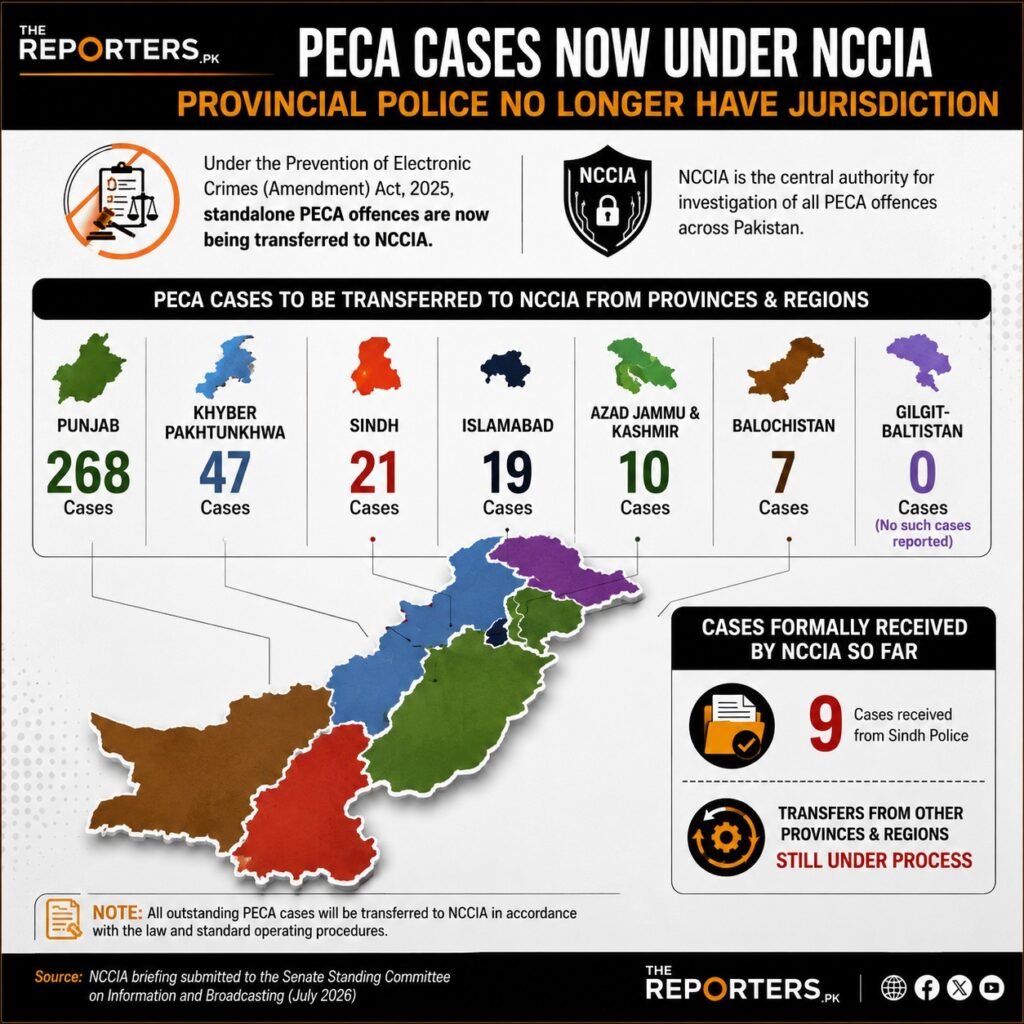
According to NCCIA, provincial police departments no longer have jurisdiction over standalone PECA offences, which are now being transferred to the agency.
The briefing states that 268 cases are to be transferred from Punjab, 47 from Khyber Pakhtunkhwa, 21 from Sindh, 19 from Islamabad, 10 from Azad Jammu and Kashmir and seven from Balochistan, while no such cases have been reported from Gilgit-Baltistan.
NCCIA informed the committee that it had formally received only nine cases from Sindh Police, while transfers from the remaining provinces were still under process.
One major question remains unanswered
While NCCIA’s latest submission answers many of the questions surrounding its 83.64 percent Meta compliance figure by linking it directly to Meta’s official Transparency Report, one issue remains unresolved.
The agency’s written clarification does not explain the methodology, technical assessment or research behind its earlier claim that 20 percent of social media accounts in Pakistan are fake.
As a result, although NCCIA has now defended one of the figures that triggered the parliamentary controversy, the statistic that generated the greatest public debate remains unsupported in the agency’s latest submission, leaving lawmakers with one key question still unanswered.