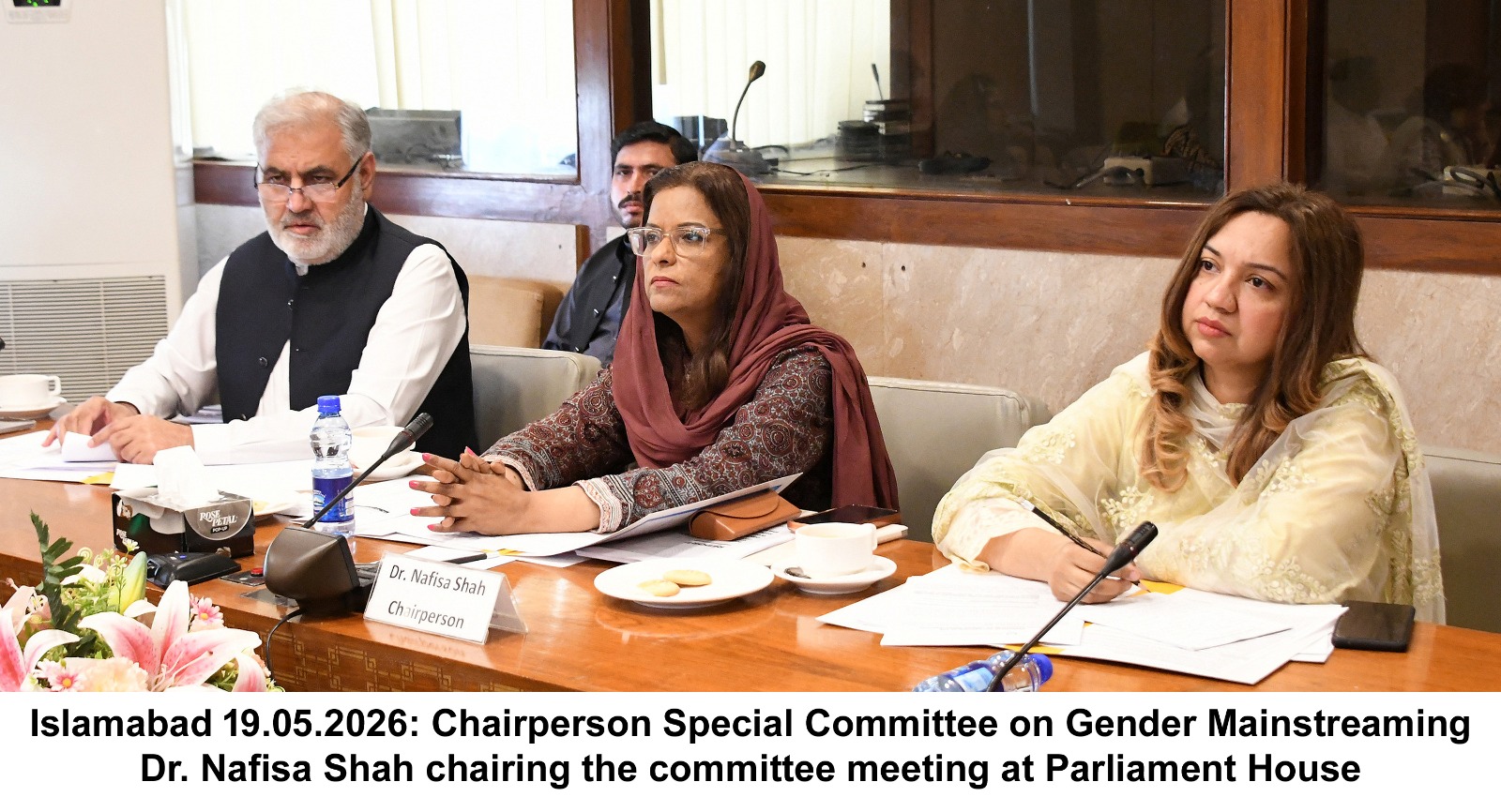

ISLAMABAD: The National Assembly’s Special Committee on Gender Mainstreaming has raised serious concerns over the government’s gender budgeting framework, lack of women-focused development projects, and repeated absence of senior officials from key ministries.
The committee meeting, chaired by Dr. Nafisa Shah, began with sharp criticism of what members described as “symbolic” gender-responsive budgeting. Opening the session, Dr. Shah revealed that only 1.3 percent of the federal budget had been allocated for women over the past five years.
The committee also expressed displeasure over the repeated absence of the Secretary of Human Rights from its meetings. Committee member Munaza Hassan questioned why the secretary had again failed to attend, saying that “no meeting is more important than a parliamentary committee meeting.”
Hassan objected to the participation of lower-ranking officers and said officials below the rank of Joint Secretary should not represent ministries in future meetings.
“Today the Director has been allowed to sit in, but this will not happen again,” she warned during the proceedings.
Responding to the criticism, a representative of the Ministry of Human Rights assured the committee that future meetings would be attended either by the Secretary or officials of Joint Secretary level.
Dr. Shah noted that the Human Rights Secretary had missed four committee meetings and confirmed that the committee was formally taking notice of the matter.
During a briefing by the Planning and Development Ministry, officials told the committee that gender considerations had been included in the government’s “Uraan Pakistan” programme and that Rs 2.5 billion had previously been allocated for related projects.
However, the committee was informed that no new project proposals had been submitted this year, prompting concern among lawmakers.
Committee member Shaista Pervaiz asked how many earlier projects had actually been implemented. Dr. Shah stressed that at least one women-focused project should be included under the Uraan Pakistan framework.
Munaza Hassan questioned what had happened to projects submitted during the last four years and asked why the Ministry of Human Rights had failed to utilise allocated funds, resulting in their lapse.
The committee also questioned the absence of the Chairperson of the National Commission on the Status of Women.
In one of the strongest observations during the meeting, Dr. Shah said the current outcome of gender budgeting translated into only 0.4 percent representation within the Public Sector Development Programme, despite repeated government claims regarding gender inclusion.
She questioned whether the upcoming federal budget could at least increase women-focused allocations to one percent of the total budget.
Committee members also discussed how “Gender Gap Analysis” was being incorporated into the PSDP. Munaza Hassan specifically asked how the framework was actually being used in development planning.
Hassan warned that international partners, including UN Women, were reconsidering support where gender-related funding was producing little measurable impact.
“If there is no benefit from these programmes, funding is being stopped,” she cautioned.
Dr. Shah said that despite a total national budget running into trillions of rupees, there was effectively no dedicated PSDP project exclusively focused on women. She also observed that the total PSDP envelope stood at approximately Rs 820 billion, yet women-focused allocations remained negligible.
The committee demanded stronger parliamentary oversight of gender budgeting. Dr. Shah directed that the attendance of the Minister of State for Law and Justice, who is also a member of the committee, should be ensured in future sessions.
Shaista Pervaiz proposed that the national budget should formally be presented in parliament through a “gender lens” framework, enabling lawmakers to assess how allocations affect women and marginalised communities.
The committee also called for an increase in women-related allocations under the Pakistan Bait-ul-Mal programme.
According to briefing documents reviewed during the meeting, lawmakers are expected to further scrutinise the government’s gender-responsive budgeting framework, women empowerment schemes, rural exclusion, and the sharp reduction in gender equity funding.
The committee is also expected to question why women-focused PSDP projects account for only a small fraction of total development spending and why key national gender data, including the National Time Use Survey, has not been updated since 2007.