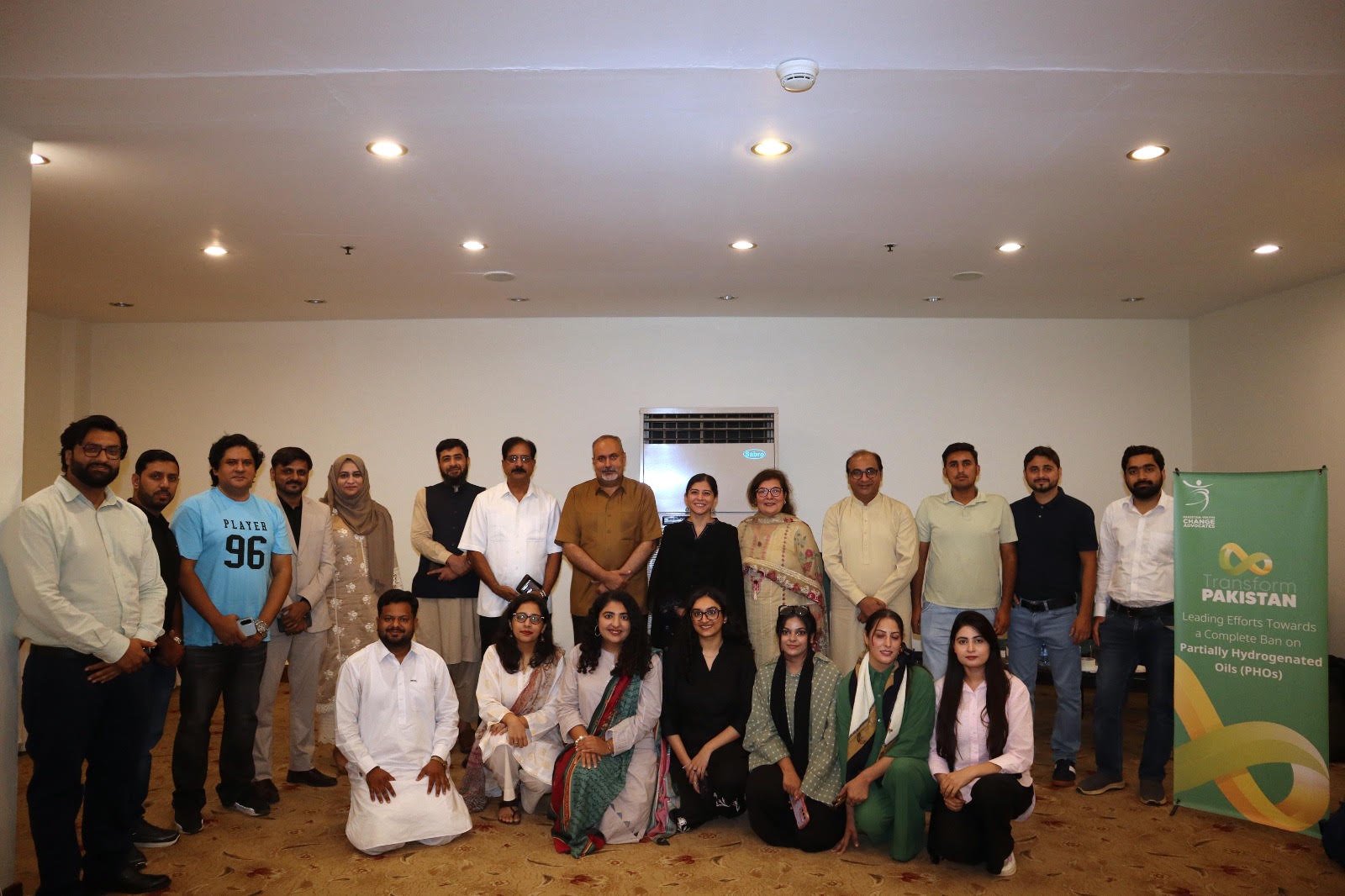

A media workshop in Islamabad this week tried to shift the conversation on food safety from scattered enforcement drives to the upstream risks built into Pakistan’s food supply. Held on World Patient Safety Day under the TRANSFORM Pakistan campaign, the session brought together young reporters and public health advocates who argued that industrial trans fats and Partially Hydrogenated Oils remain a silent driver of the country’s noncommunicable disease burden.
Speakers framed the issue plainly. Industrial trans fats, created through the partial hydrogenation of edible oils, have no health benefits and sharply raise the risk of heart disease, diabetes, cancers, Alzheimer’s disease, obesity, stroke and infertility. Nutrition expert Munawar Hussain told participants that between 2023 and 2026 these fats were linked to an estimated 45,000 deaths and economic losses of USD 1.3 billion. He urged journalists to ask regulators for the methodology behind these figures, noting that Pakistan’s NCD data gaps make transparency essential.
Heartfile’s chief executive, Dr Saba Amjad, shared findings from the organisation’s recent street‑food study, which she said shows bakery products and banaspati fats remain major contributors to dietary trans-fat exposure. She encouraged reporters to request the full study from Heartfile, since it is not publicly available. Her point echoed a broader theme of the workshop: evidence exists, but it is scattered, and journalists can help bring it into public view.
The regulatory timeline shows why that matters. Pakistan Standards and Quality Control Authority set a five percent limit for vanaspati ghee in 2020, tightened it to two percent for several categories in 2023, expanded coverage to dozens more in 2024 and finally adopted a two percent limit across all foods in March 2025. WHO recognises two best‑practice routes, either a two percent limit or a complete ban on PHOs. An official suggested a hybrid approach in 2024, with a PHO ban to follow. Whether that ban is still planned is a question journalists can put to federal and provincial authorities.
The strongest news hook lies in enforcement. A Pakistan Council of Scientific and Industrial Research report presented to the National Price Monitoring Committee in August found that nearly half of 491 samples of banaspati ghee, edible oils and milk products failed standards. Trans fat levels in some ghee reached 15.87 grams per 100 grams, almost eight times the legal limit. Non‑conformance varied sharply by province, from 79.4 percent in Balochistan to 5.5 percent in Islamabad. Planning Minister Ahsan Iqbal directed action against manufacturers and ordered quarterly monitoring, including in rural markets. His claim that substandard food is contributing to rising heart attacks among young people is his own assessment and should be attributed as such.


The workshop also touched on Pakistan’s fragmented food‑safety system. A 2019 Council of Common Interests decision placed standard‑setting with the federal government and enforcement with the provinces, removing a revenue stream and enforcement lever from provincial authorities. A 2025 legal analysis found that while provincial laws exist, enforcement remains uneven because of limited resources, overlapping jurisdiction, weak prosecution and the absence of a national food safety policy. Punjab has recently launched a new Agriculture, Food and Drug Authority to merge 23 laboratories under one framework. Other provinces continue periodic crackdowns, such as the destruction of thousands of litres of substandard milk and adulterated ketchup in Khyber Pakhtunkhwa this July.
The broader health context is stark. WHO says NCDs account for 74 percent of global deaths. Its regional office estimates they contribute to about 57 percent of deaths in Pakistan, though newer figures are needed. Pakistan’s cardiovascular death rate is far above the global average. Diabetes affects roughly 26 percent of adults, with more than a third of cases undiagnosed. FAO estimates one in five Pakistanis suffers a foodborne illness each year, twice the global average, costing about USD 1.7 billion in lost productivity. WHO has warned that trans-fat intake causes hundreds of thousands of premature coronary deaths worldwide each year and has listed Pakistan among countries with a high share of such deaths and no best‑practice policy until recently.
Speakers at the workshop argued that media sensitisation helped pave the way for the 2025 standard. Young people, who make up about 64 percent of the population, pushed the issue through podcasts, op‑eds and social media. PYCA’s advocacy lead, Afshar Iqbal, said safe food should not depend on geography or income. Executive Director Areebah Shahid said journalists have a vital role in translating complex food‑policy issues into information that policymakers and the public can act on. She said TRANSFORM Pakistan aims to support a stronger evidence‑based conversation on industrial trans fats and PHOs and encourage accountability so preventable risks are addressed at their source.
For reporters, the path forward is clear. Follow the enforcement gap. Ask PSQCA and provincial food authorities how many violations have been prosecuted and who has been penalised. Explain terms such as PHOs, industrial trans fats and the two gram per 100 gram limit. Use human voices, from cardiologists to street‑food vendors and patients. Ask whether trans-fat labelling is required and whether products are tested. Balance advocacy claims with regulator and industry responses, especially from vanaspati manufacturers.
The workshop’s message was that safer food policy is not only a technical matter. It is a public conversation shaped by what journalists choose to highlight. With stronger reporting, the momentum behind Pakistan’s food‑safety reforms can grow, and the country’s rising burden of preventable disease can be tackled further upstream, long before it reaches the clinic.