Child Abuse Cases: KP Trial Backlog More Than Doubles, Punjab Acquittals Rise by 80%, Tribal Districts Record 15.5% Convictions
Exclusive parliamentary data reveal rising reported offences against children, mounting trial backlogs and low conviction rates

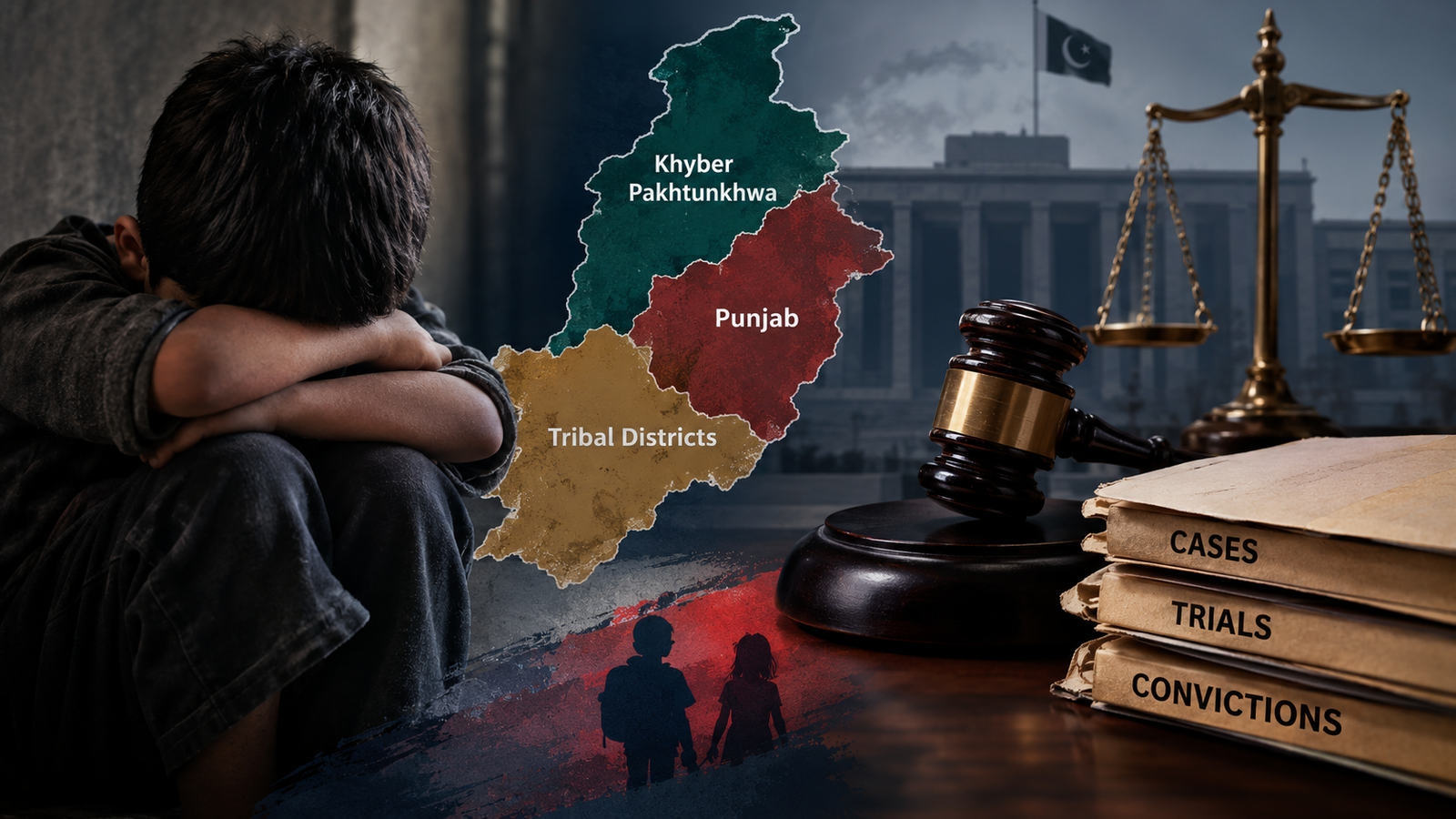

ISLAMABAD: The number of cases involving serious offences against children remains a major concern across 3 jurisdictions, with parliamentary data revealing rising case registrations in Khyber Pakhtunkhwa (KP), a growing backlog of pending cases in Punjab and low conviction rates in the tribal districts.
In KP, 570 cases were registered during January–September 2026, nearly matching the 579 recorded throughout 2025. The number of cases pending trial in the province more than doubled between the end of 2024 and September 2026. In Punjab, acquittals increased by approximately 79.7% between 2024 and 2025, while the number of pending cases reached 4,582 by July 2026. In the tribal districts, only 853 of 5,496 concluded trials resulted in convictions during the reporting periods, producing an overall reported conviction rate of 15.5%.
The data, obtained by The Reporters and presented in the Senate of Pakistan, cover child rape, gang rape, murder, sexual abuse and other offences. They also include figures on arrests, investigations, challans, court disposals, convictions, acquittals and pending trials.
The records offer different views of the criminal justice process rather than a complete account of each case from registration to final judgment. Nevertheless, they highlight significant trends that warrant scrutiny by police, prosecution services, judicial authorities and child-protection institutions.
Khyber Pakhtunkhwa: Boys account for 77% of recorded victims as cases rise
One of the most striking findings in KP’s data is the number of boys recorded as victims across the offence categories covered by the dataset. The records list 1,283 male victims and 381 female victims across 2024, 2025 and January–September 2026, bringing the total to 1,664. Boys accounted for approximately 77% of these recorded victims.


The figures cover multiple offences, including child rape, gang rape, murder and other serious crimes against children. They do not, however, provide a separate gender breakdown specifically for sexual offences. The data therefore cannot establish what proportion of the recorded boys were victims of sexual abuse rather than other crimes.In 2024, the dataset recorded 374 male and 128 female victims. In 2025, the figures were 461 male and 128 female victims. During January–September 2026, 448 male and 125 female victims were recorded.
The figures show that male victims outnumbered female victims in each reporting period. The original records should also be checked to clarify why the total of 1,664 recorded victims exceeds the 1,641 registered cases reported across the same periods. Multiple victims in individual cases could explain the difference, but this requires confirmation from the source.
Child rape cases exceed the previous year’s total
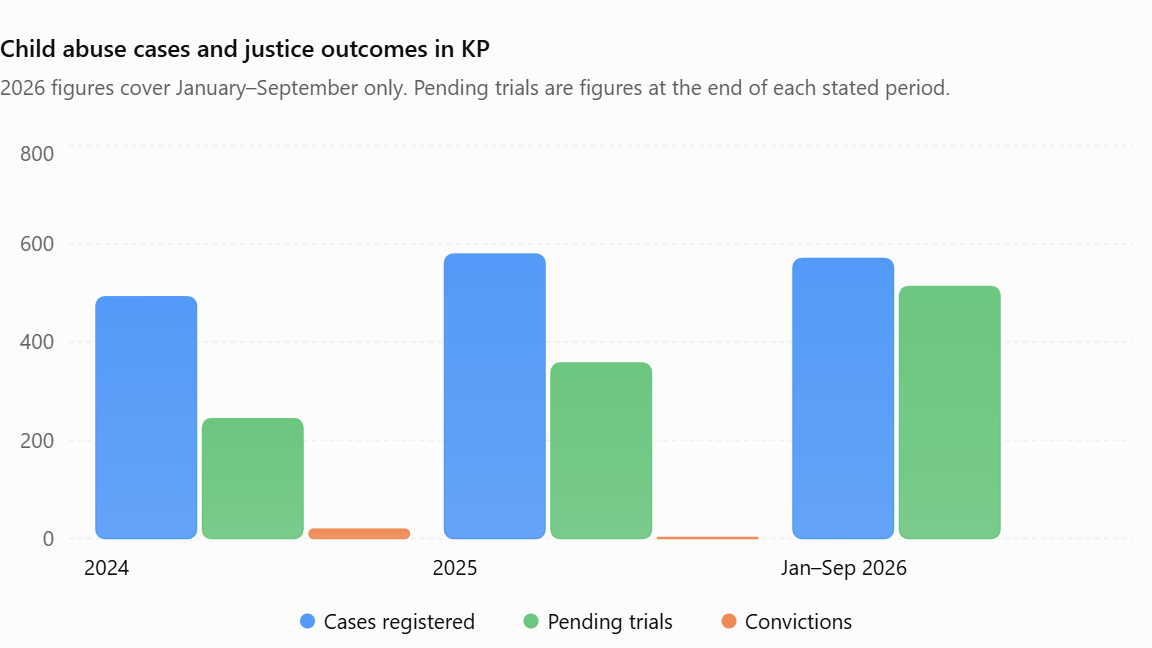
KP registered 492 cases involving serious offences against children in 2024 and 579 in 2025, an increase of 17.7%.During January–September 2026, another 570 cases were registered, equivalent to 98.4% of the total recorded throughout 2025. The monthly average increased from approximately 41 cases in 2024 to 48 in 2025 and 63 during the first 9 months of 2026.
Child rape accounted for the largest category in the dataset. Police registered 386 cases in 2024 and 455 in 2025, an increase of approximately 17.9%. During January–September 2026, another 463 cases were recorded, already exceeding the entire 2025 total by 8 cases.
Cases classified as child gang rape increased from 3 in 2024 to 8 in 2025 and 18 during January–September 2026. The records also list 9 cases of child rape with murder in 2024 and 8 each in 2025 and the first 9 months of 2026.These figures establish a concerning pattern in reported offences, although they cannot independently determine whether the increases reflect a rise in actual incidents, changes in reporting or other factors.
2026 figures cover January–September only. Pending trials are figures at the end of each stated period.
Pending trials more than double
The number of cases awaiting trial rose from 244 at the end of 2024 to 357 at the end of 2025. By September 2026, the pending-trial count had reached 513, an increase of approximately 110.2% compared with the end of 2024.The records list 828 accused persons charged and 776 arrested in 2024. In 2025, 994 accused persons were charged and 913 arrested. During January–September 2026, 905 were charged and 826 arrested.
Across the 3 reporting periods, the dataset records 2,727 accused persons charged and 2,515 arrested. It also lists 1,611 challaned cases, 4 cases classified as untraced and 30 cases under investigation.
The number of convictions recorded was 19 in 2024, 2 in 2025 and none during January–September 2026. These are convictions recorded during the respective reporting periods, not necessarily the final outcomes of cases registered in those same years.The available data do not support a reliable conviction ratio for KP comparable with the figures available for Punjab and the tribal districts. Calculating a percentage by dividing convictions recorded in a particular year by cases registered during that year would risk comparing different groups of cases.
Punjab: Pending cases reach 4,582 as acquittals rise by nearly 80%
Punjab’s court records reveal a growing balance of unresolved cases and a substantial increase in acquittals between 2024 and 2025.Courts disposed of 2,403 cases in 2024 and 2,641 in 2025. During January–July 2026, another 1,782 cases were disposed of.
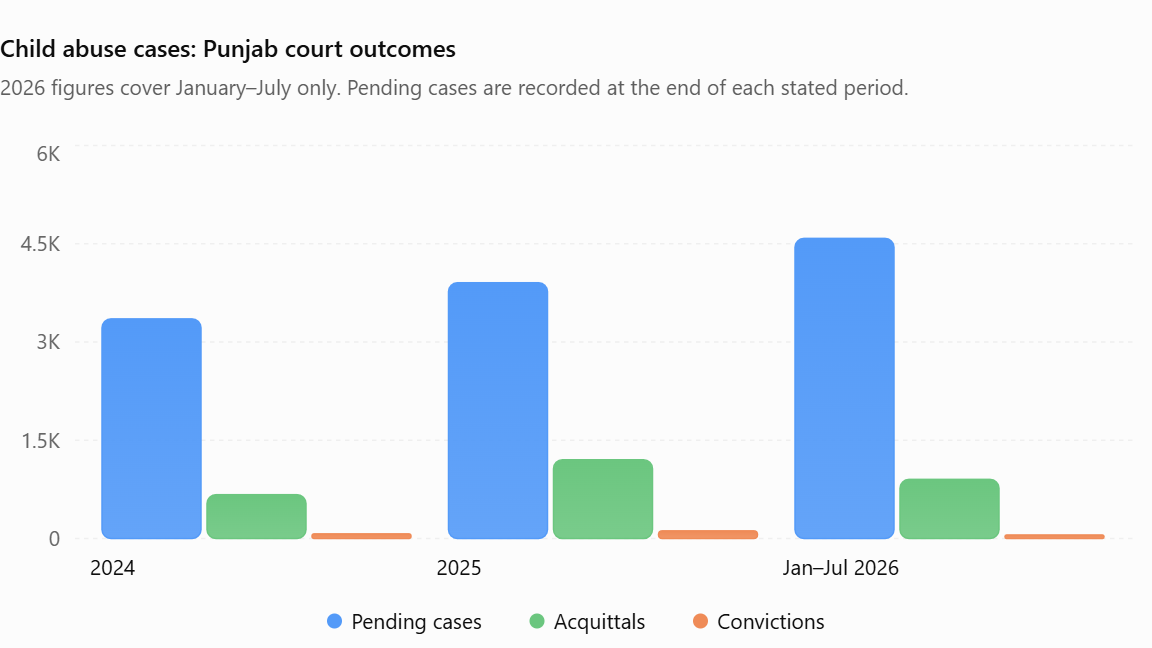
The closing balance of pending cases increased from 3,353 at the end of 2024 to 3,905 at the end of 2025. By July 2026, it had reached 4,582, an increase of approximately 17.3% compared with the end of 2025.
The rising balance indicates that the number of unresolved cases continued to grow despite the disposal of thousands of cases during the reporting periods. The aggregate figures do not, however, establish how long individual cases have remained pending or what has caused the delays.
Acquittals increase by 79.7% in 1 year
Punjab recorded 669 acquittals in 2024 and 1,202 in 2025, an increase of approximately 79.7%. During January–July 2026, another 903 acquittals were recorded.Convictions numbered 71 in 2024, 117 in 2025 and 54 during the first 7 months of 2026.
According to the source, convictions represented 2.95% of total case disposals in 2024, 4.43% in 2025 and 3.03% during January–July 2026.
The conviction-to-disposal ratio improved in 2025 before declining during the first 7 months of 2026. These percentages describe convictions as a share of all recorded disposals. They should not be interpreted as the proportion of cases registered in a particular year that ultimately resulted in conviction.
2026 figures cover January–July only. Pending cases are recorded at the end of each stated period.
Witnesses resiling from testimony feature prominently in acquittals
One of the most significant findings in Punjab’s data concerns acquittals attributed to witnesses resiling from their testimony.The records list 563 such acquittals in 2024, increasing to 967 in 2025. During January–July 2026, the figure stood at 775.These accounted for approximately 84.2% of acquittals in 2024, 80.4% in 2025 and 85.8% during the first 7 months of 2026.
The figures raise questions about the circumstances in which witnesses withdraw or change their testimony, particularly in cases involving children who may be vulnerable to pressure. However, the data do not establish why witnesses resiled or whether intimidation, financial pressure, family influence or other circumstances were involved.
Establishing those explanations would require examination of individual judgments and interviews with witnesses, lawyers, prosecutors and child-protection specialists.The records also list 97 acquittals following full trial in 2024, 189 in 2025 and 94 during January–July 2026. Acquittals under insufficient evidence or other grounds numbered 9, 46 and 32, respectively. A further 2 acquittals following compromise were recorded during the first 7 months of 2026, compared with none in the preceding 2 full years.
Punjab’s conviction ratio
Using convictions divided by total recorded disposals, Punjab’s reported conviction ratios were 2.95% in 2024, 4.43% in 2025 and 3.03% during January–July 2026.
These ratios differ from calculations that divide convictions by the combined number of convictions and acquittals. They also do not establish the ultimate outcome of cases registered in the same year, because court disposals may include cases registered earlier.The data therefore point to a low conviction-to-disposal ratio under this particular calculation, alongside a growing pending balance and a high number of acquittals attributed to witnesses resiling from testimony.
Tribal districts: Only 15.5% of concluded trials result in conviction
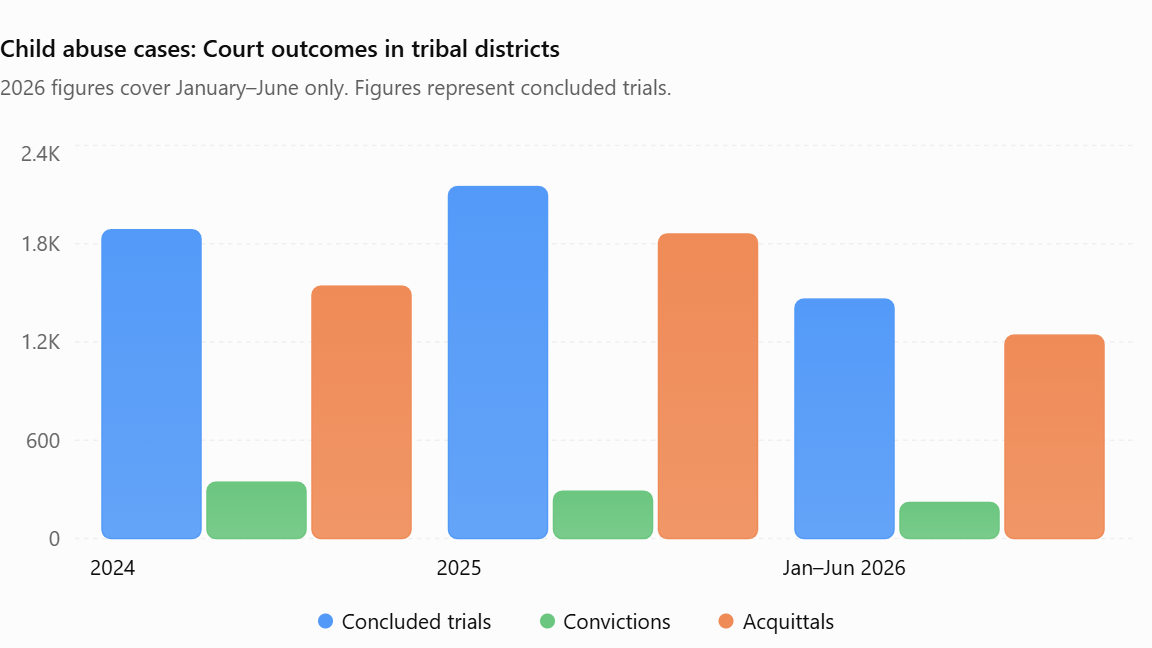
The trial-outcome data for the tribal districts cover 2024, 2025 and January–June 2026. During these periods, 5,496 trials were concluded. Of these, 853 resulted in convictions and 4,643 in acquittals.
The overall reported conviction rate was 15.5%, meaning approximately 1 in every 6.4 concluded trials resulted in conviction.In 2024, 1,885 trials were concluded, resulting in 344 convictions and 1,541 acquittals. The reported conviction rate was 18.2%.In 2025, 2,149 trials were concluded, with 289 convictions and 1,860 acquittals. The conviction rate fell to 13.4%.
During January–June 2026, 1,462 trials were concluded. Of these, 220 resulted in convictions and 1,242 in acquittals, producing a reported conviction rate of 15%.The conviction rate declined by 4.8 percentage points between 2024 and 2025 before recovering by 1.6 percentage points during the first half of 2026. The latest rate remained below the 18.2% reported for 2024.
Child sexual abuse cases record a conviction rate of approximately 5%
For rape, the reported conviction rate stood at 7% in 2024, 4% in 2025 and 5% during January–June 2026.The child sexual abuse category recorded 536 concluded trials in 2025. Of these, 28 resulted in convictions and 508 in acquittals, producing a conviction rate of approximately 5.2%, reported in the source as 5%.During January–June 2026, 263 trials were concluded in this category. Fourteen resulted in convictions and 249 in acquittals, producing a conviction rate of approximately 5.3%, again reported as 5%.
The source defines child sexual abuse broadly, including rape, gang rape, sodomy, sexual abuse, kidnapping and physical torture, as labelled in the document.The figures show that convictions accounted for a small proportion of concluded trials in this category during the reporting periods. They do not explain why the remaining cases ended in acquittal or establish whether those outcomes resulted from weaknesses in investigations, prosecution, evidence or other circumstances.
2026 figures cover January–June only. Figures represent concluded trials.
Tribal districts’ conviction ratio
Across all categories, the reported conviction rate was 15.5% for the 5,496 concluded trials. In the child sexual abuse category, the rate remained approximately 5% in both 2025 and the first half of 2026.
These ratios are based on concluded trials, not all complaints or cases registered during the same periods. They therefore cannot be directly compared with Punjab’s conviction-to-total-disposal ratios without accounting for the different denominators and definitions.
What the figures reveal about justice for children
In KP, the number of registered cases in the first 9 months of 2026 nearly matched the total for the previous full year, while pending trials increased by approximately 110.2% between the end of 2024 and September 2026. The gender breakdown also shows that boys accounted for approximately 77% of recorded victims across multiple offence categories, although the available data do not establish how many boys were specifically victims of sexual offences.
In Punjab, the pending balance reached 4,582 by July 2026, while acquittals increased by approximately 79.7% between 2024 and 2025. Acquittals attributed to witnesses resiling from testimony accounted for approximately 85.8% of recorded acquittals during January–July 2026.
In the tribal districts, 4,643 of 5,496 concluded trials ended in acquittals during the reporting periods, resulting in an overall reported conviction rate of 15.5%. The rate for the broadly defined child sexual abuse category remained approximately 5% in 2025 and the first half of 2026.