Pakistan Cannot Afford to Treat Climate Change as an Optional Expense

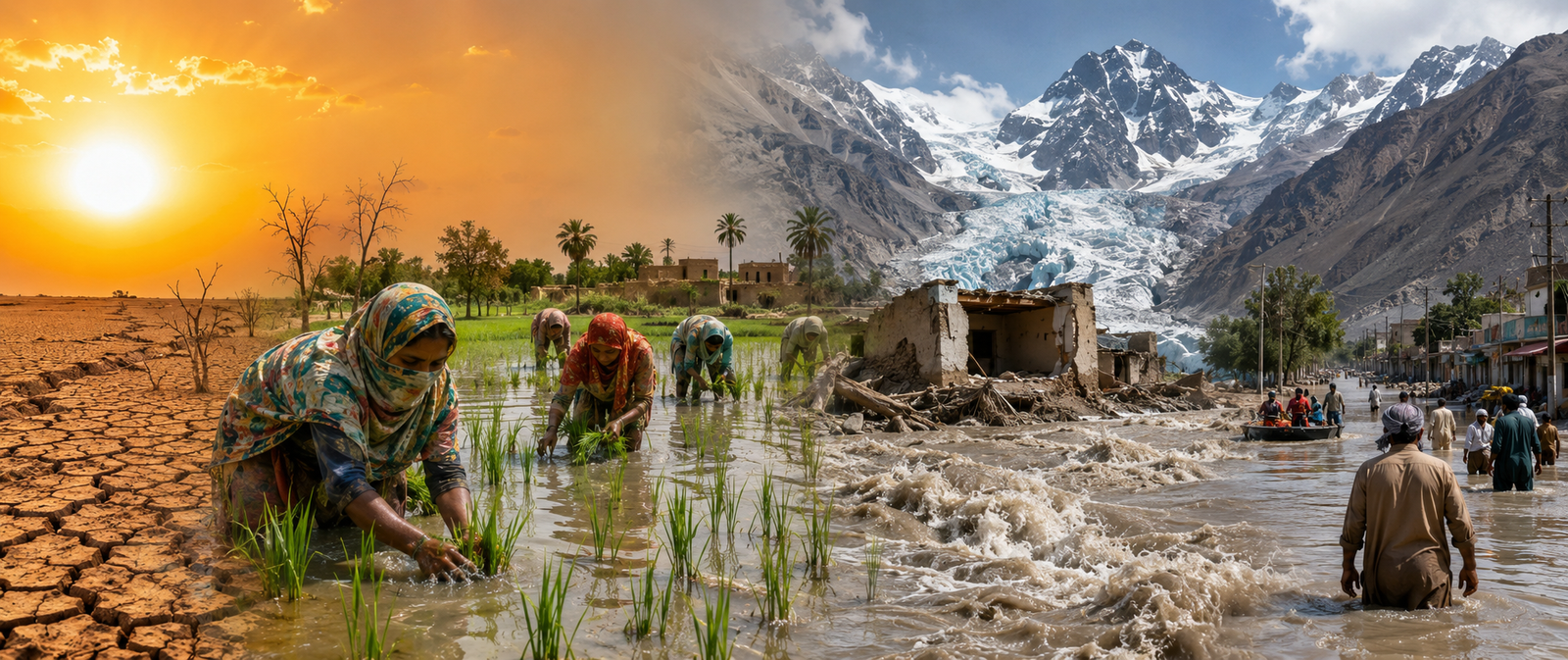

By nine o’clock on a June morning, the rice nurseries and maize fields in a small village near Sahiwal are already shimmering beneath an unforgiving sun. Women move slowly through ankle-deep water, transplanting rice seedlings, while others cut fodder or tend vegetable plots with scarves wrapped tightly around their faces—not to shield themselves from dust, but from a heat that has become far more intense than the summers they remember.
There are no cooling shelters in these fields. No shaded rest areas. No ambulance waiting nearby if someone collapses from heat exhaustion. Work cannot stop because missing a day’s wages may mean there is no food on the table. So they continue—bending for hours under an unforgiving sky, carrying bundles of fodder and working through temperatures approaching 45°C.
For these women, climate change is not an abstract debate discussed at international conferences or in government policy papers. It is the burning water beneath their feet in flooded rice fields, the dizziness that comes before dehydration, the shrinking harvest that threatens household income and the growing uncertainty over whether the coming weeks will bring drought, flash floods or another record-breaking heatwave.
This year, those fears are becoming reality once again. The National Disaster Management Authority (NDMA), together with the Pakistan Meteorological Department (PMD), has warned that above-normal monsoon rainfall projected to be 22 to 26 per cent above average combined with intense heat is accelerating glacier melt across Gilgit-Baltistan, Khyber Pakhtunkhwa and Azad Jammu and Kashmir. The agencies have cautioned that rapidly rising river levels, glacial lake outburst floods (GLOFs), flash floods, landslides and urban flooding could threaten communities across the country in the weeks ahead.
Yet, at precisely the moment when Pakistan should be strengthening its climate resilience, the federal government’s latest budget has moved in the opposite direction. Climate-related development spending has reportedly been reduced across several key sectors. Funding for climate mitigation has fallen from Rs603 billion to Rs124 billion, adaptation allocations have been cut to Rs70 billion, while the Public Sector Development Programme allocation for the Ministry of Climate Change and Environmental Coordination has dropped to Rs2.48 billion.

No government has unlimited fiscal space, and Pakistan’s economic constraints are undeniable. But budgets are more than accounting exercises , they are statements of national priorities. When climate risks grow year after year while investment in preparedness shrinks, an uncomfortable question emerges: Can one of the world’s most climate-vulnerable countries afford to treat climate resilience as an optional expense?
The evidence increasingly suggests that it cannot.
Pakistan contributes less than one per cent of global greenhouse gas emissions, yet it consistently ranks among the countries most vulnerable to climate-induced disasters. It is a cruel paradox of the climate crisis: those who have contributed the least to global warming are often paying the highest price. While industrialised nations built their economies over decades through carbon-intensive growth, countries like Pakistan are now bearing the consequences in the form of devastating floods, prolonged droughts, deadly heatwaves and accelerating glacier melt.
But Pakistan cannot afford to view climate change merely as an injustice imposed by others. Whether the country caused the crisis or not, it must now confront its consequences. Climate change is no longer simply an environmental challenge. It has become an economic crisis, a public health emergency, a food security threat and, increasingly, a test of governance itself.
The devastating floods of 2022 should have fundamentally changed how Pakistan thinks about climate spending. Affecting more than 33 million people, the disaster submerged villages, washed away roads, destroyed schools and hospitals, devastated crops and displaced millions. The Pakistan Floods 2022 Post-Disaster Needs Assessment, prepared jointly by the Government of Pakistan, the World Bank, the Asian Development Bank, the European Union and the United Nations, estimated physical damages of more than US$14.9 billion, economic losses exceeding US$15.2 billion, while reconstruction and rehabilitation needs surpassed US$16.3 billion.
Those numbers represent much more than statistics. They reflect children whose education was interrupted after schools were destroyed, farmers who lost an entire year’s income, families forced to rebuild homes from scratch and small businesses that never reopened. The disaster demonstrated that climate shocks are capable of wiping out years of development in a matter of weeks.
It also exposed a costly misconception that still shapes public policy, that climate spending is somehow separate from development spending.
In reality, every road, bridge, hospital, school, irrigation canal and electricity transmission line becomes vulnerable if climate resilience is ignored. Every rupee invested in adaptation today has the potential to save several more in emergency relief, reconstruction and economic losses tomorrow. Disaster response will always be more expensive than disaster prevention.
This is precisely why the Global Commission on Adaptation, in its landmark report Adapt Now, argues that investments in climate resilience generate some of the highest economic returns available to governments. Adaptation is no longer simply about protecting forests, glaciers or biodiversity. It is about protecting economies, reducing poverty and ensuring that development gains are not repeatedly erased by increasingly frequent disasters.Pakistan’s economy already offers compelling evidence of this reality.
Agriculture remains one of the country’s largest employers and a critical contributor to food security, exports and rural livelihoods. Yet it is becoming increasingly difficult for farmers to rely on weather patterns that once shaped planting and harvesting seasons. Heatwaves are reducing crop yields, erratic rainfall is disrupting sowing schedules, prolonged dry spells are increasing dependence on irrigation, while sudden downpours are destroying standing crops within hours.
Reduced agricultural production contributes to rising food prices. Water shortages increase production costs. Flood-damaged roads interrupt supply chains, while extreme weather raises insurance and transportation expenses. Climate change therefore becomes an inflationary force, affecting urban consumers as much as rural producers.Increasingly, it is becoming difficult to separate economic policy from climate policy.
Extreme heat also carries a hidden economic cost that rarely appears in budget speeches.
Across Pakistan, construction workers, sanitation staff, traffic police officers, delivery riders, street vendors and millions of daily wage labourers continue working under dangerous temperatures because taking a day off simply is not financially possible. Missing work often means missing meals.
The International Labour Organization (ILO) warns that South Asia is among the regions most severely affected by occupational heat stress. Pakistan is expected to experience significant declines in labour productivity as rising temperatures and humidity reduce safe working hours, particularly in agriculture and construction. For a country where millions depend on outdoor work, climate change is already reducing incomes long before floods destroy crops or storms damage infrastructure.
Yet perhaps the greatest irony is that climate change is still too often discussed as if it belongs solely to environmental ministries.It does not.It belongs in the Ministry of Finance because climate disasters threaten economic stability. It belongs in the Ministry of National Health Services because heatwaves, floods and changing disease patterns are becoming major public health challenges. It belongs in the Ministry of Planning because infrastructure built today must withstand tomorrow’s climate. It belongs in provincial governments because cities and districts are increasingly on the frontline of climate impacts.
In truth, climate resilience should no longer be viewed as one ministry’s responsibility. It should be embedded in every public policy decision the country makes.If climate change is reshaping Pakistan’s economy, it is also steadily transforming its public health landscape.
The consequences are becoming increasingly visible every summer. Hospitals report rising numbers of patients suffering from heat exhaustion, dehydration and heatstroke. Extreme temperatures place additional strain on people living with cardiovascular and respiratory diseases, while prolonged exposure to heat can trigger kidney-related illnesses, particularly among labourers who spend long hours outdoors.
The health impacts do not end when the heat subsides. Floods contaminate drinking water, increasing the spread of waterborne diseases such as cholera and diarrhoea. Standing water after heavy rains creates breeding grounds for mosquitoes, contributing to outbreaks of dengue and malaria. Children, the elderly, pregnant women and those with existing health conditions are often the first to bear the consequences.
Urban flooding is also the result of decades of poor planning, shrinking green spaces, blocked drainage systems, unchecked construction over natural waterways and weak enforcement of building regulations. Climate change does not create clogged drains or illegal encroachments. It exposes the cost of ignoring them.
That is why the recent warnings issued by the NDMA and the Pakistan Meteorological Department deserve far greater attention than they often receive. The agencies have warned that above-normal monsoon rainfall, estimated to be between 22 and 26 per cent higher than average—combined with accelerated glacier melt could significantly increase the risks of flash floods, glacial lake outburst floods, landslides and urban flooding. Citizens have been advised to avoid unnecessary travel in vulnerable areas and remain alert to rapidly changing weather conditions.
Such warnings should not be viewed as routine seasonal advisories. They are indicators of a changing climate that is stretching Pakistan’s infrastructure beyond the conditions for which much of it was originally designed. This is why climate change must also be understood as a governance challenge.
Climate financing, whether domestic or international, must be monitored carefully to ensure that funds translate into measurable improvements rather than isolated projects or political announcements. Pakistan has successfully mobilised international climate finance in recent years, yet implementation has often lagged behind ambition. Better institutions, stronger oversight and evidence-based policymaking will determine whether future investments deliver meaningful resilience.
Climate change does not negotiate with politics. It does not wait for budget revisions, election cycles or improvements in the economy. Every summer is becoming hotter than the last. Every monsoon is growing more unpredictable. Every flood is becoming more expensive, and every disaster is exposing weaknesses that should have been addressed long before the first emergency alert was issued.
Pakistan cannot continue treating climate resilience as discretionary spending while climate disasters become permanent features of national life. Adaptation should not be confined to one ministry’s budget; it must become part of every ministry’s planning, from finance and agriculture to health, education, housing and urban development.
The question facing Pakistan is no longer whether climate change is real or whether the country can stop it alone. The question is whether public policy can shift from reacting to disasters after they occur to preparing for them before they strike.
For a country that contributes less than one per cent of global greenhouse gas emissions yet stands on the frontline of the climate crisis, preparedness is not an environmental luxury. It is an economic necessity, a public health imperative and a national security requirement.The real question is no longer whether Pakistan can afford to invest in climate action.It is whether Pakistan can afford not to?