LUMHS, Sindh Information Commission at Odds Over Record Inspection

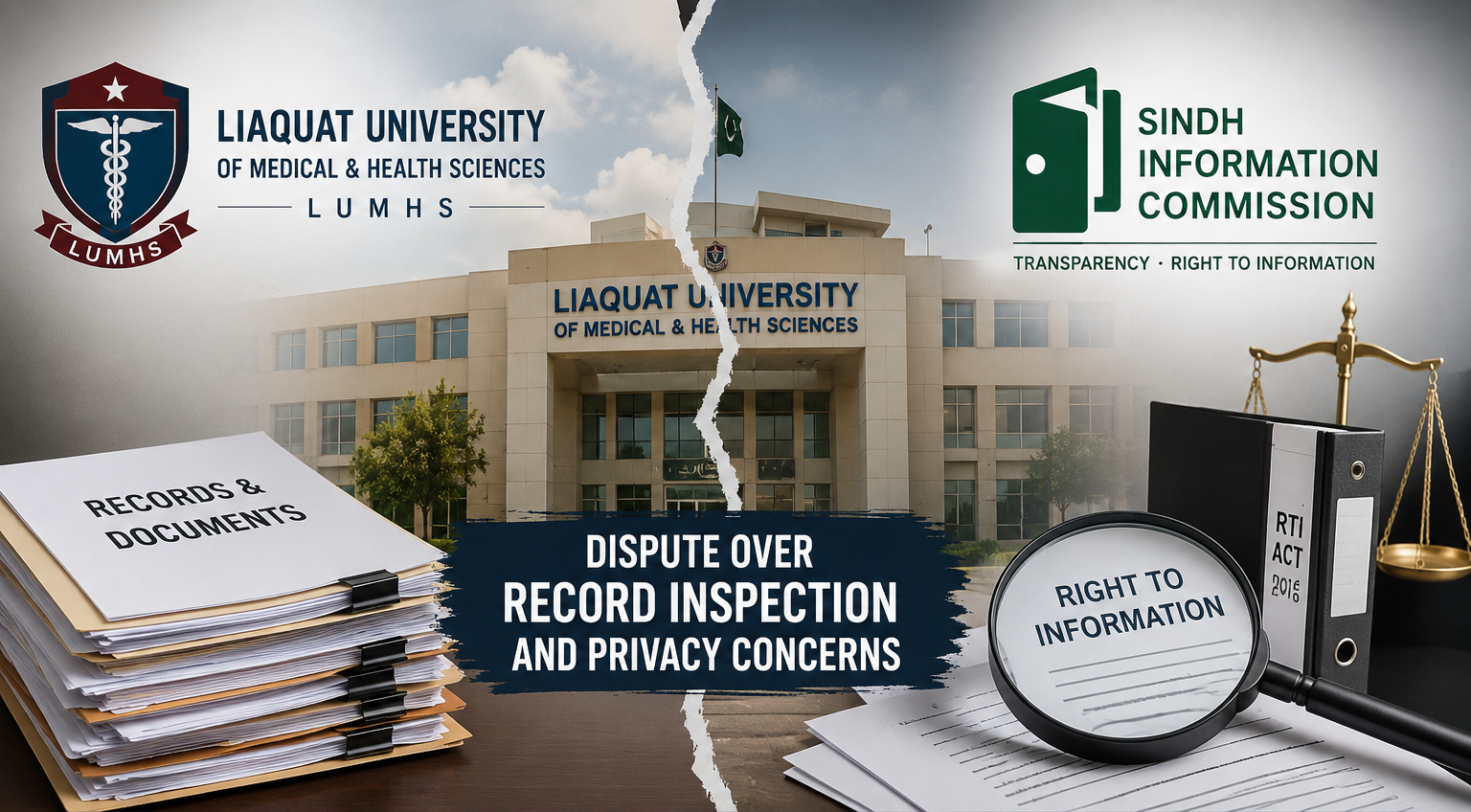

A dispute has surfaced between the Liaquat University of Medical & Health Sciences (LUMHS) and the Sindh Information Commission (SIC) over the commission’s recent visit to the university for inspection of records linked to long-pending complaints, with both sides defending their positions on transparency and privacy.
The controversy began after LUMHS wrote to the provincial information secretary, expressing reservations about the conduct of the SIC during its visit to the university. The commission, however, has rejected the university’s concerns, maintaining that the inspection was carried out strictly in accordance with the law and under its order dated June 2.
Responding to the university’s letter, an SIC spokesperson said the commission’s visit was related to complaints that had been pending for a considerable period and that the inspection was aimed at verifying records after the requested information remained unavailable despite repeated reminders.
The spokesperson said the publication of news regarding the visit was intended solely to inform the public about the commission’s activities and pointed out that the report had, in fact, praised the functioning of the LUMHS website.
“The question of harming the university does not arise,” the spokesperson said.


The SIC further argued that it is a statutory body established to ensure implementation of the right of access to information guaranteed under Article 19 of the Constitution and that it derives its powers from Section 13(4) of the Sindh Transparency and Right to Information Act, 2016.
SIC member Noor Mohammad Dayo said the commission is empowered to entertain complaints from any individual, irrespective of his or her locus standi, if the complaint raises issues relating to transparency in a public sector organisation.
He maintained that the Sindh Transparency and Right to Information Act, 2016 supersedes the university’s internal rules, adding that a similar argument had previously been advanced by the Sindh Public Service Commission on the basis of its own regulations.
Addressing criticism over videography and photography during the visit, Mr Dayo said the recordings were made solely for the commission’s official record and reporting purposes and were not intended to harm the university in any manner.
LUMHS, however, has remained unconvinced by the commission’s explanation.
A university spokesperson said the administration had serious concerns because the complaint in question was filed by an individual seeking credentials and bio-data of three female students. According to the spokesperson, facilitating such a request in favour of a private individual would be contrary to the law.
The university further stated that SIC members were provided with all the required documents in a smooth and cooperative manner. However, it expressed concern that the privacy and dignity of the institution and its officials were not adequately protected during the inspection process.
The spokesperson argued that unauthorised videography, photography and dissemination of such material through social and electronic media are prohibited under the law and could adversely affect the privacy, dignity and reputation of individuals and organisations without justification.
The dispute has brought into sharp focus the delicate balance between the public’s right to information and the protection of privacy, as both the university and the commission continue to defend their interpretation of the law and their conduct in the matter.