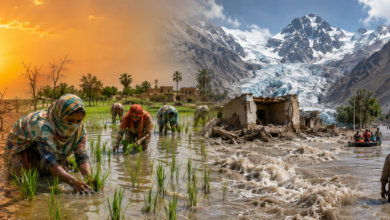

If we look back 20 to 25 years, according to the natural order and system, spring used to begin in early February. Buds would start appearing on plants and trees, summer would begin in April, and winter would start in September. However, in the present era, spring now begins around 10 to 15 March, while summer starts between 15 to 20 May. Nature itself reflects a shift of almost one and a half months in seasonal patterns. Along with natural factors, human activities also play a major role in environmental and climate change.
One of the most significant causes is the disturbance of the earth’s natural system, including unplanned land erosion and changes in the natural landscape. If we examine the Potohar region, most of its land traditionally consisted of rugged terrain, hills, fertile fields, trees, clean water springs, streams, rivers, herbs, wildlife, insects, and a beautiful natural environment that fulfilled both ecological and scientific requirements. It was a balanced and self-sustaining system.
The charming scenes of spring, green crops, forests, berry trees, wild mulberries, figs, banyan trees, keekar trees, and many other native plants once served as a natural source of oxygen, food, pleasant weather, and environmental stability. The natural high and low structure of the land had its own purpose. During hot weather, warm air would pass through the cracked soil and trees, rise upward, and be replaced by cooler air, creating a refreshing atmosphere rich in oxygen.
When it rained, water did not rapidly flow into streets and drains. Instead, it would spread across fields, streams, and springs, allowing groundwater levels to rise. The soil retained moisture, keeping the weather cool and pleasant. Unfortunately, due to poor planning, negligence by institutions and governments, and the desire for quick wealth through the sale of fertile land, this entire natural system has been severely disrupted. As a result, we are now facing extreme environmental and climate change.
Almost all agricultural land in the Potohar region and across the country has been transformed into housing societies, commercial plazas, markets, wedding halls, and offices. Large chillers, industrial plants, and air conditioners are now everywhere, even in vehicles. The gases emitted from these cooling systems are polluting the atmosphere. According to estimates, around 500,000 to 700,000 vehicles enter and leave Islamabad daily. The excessive use of petrol and air conditioners is increasing air pollution. Toxic gases in the atmosphere are rising while oxygen levels continue to decline.
At the same time, the natural structure of the earth has been leveled. As a result, the natural release and circulation of gases from the soil have decreased. Areas that once had rough landscapes are now covered with roads, commercial centers, shops, and housing schemes. Fields and barns have disappeared. Rainwater now flows directly into sewage drains instead of soaking into the earth. Consequently, the land remains hotter, natural streams are turning into sewage channels, and beautiful birds are disappearing or migrating.
The green parrots of Potohar have almost vanished. Peanuts are becoming rare, and berry trees are nowhere to be seen. If one traveled from Rawalpindi through Rawat, Gujar Khan, Jhelum, and onward to Lahore in the past, one would see water streams, trees, mustard fields, maize, rice, and sugarcane everywhere. Today, however, only shops and housing societies dominate the landscape.
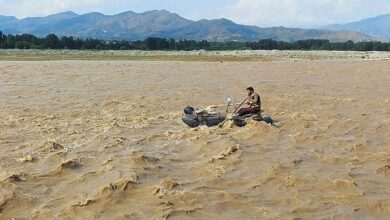
The Soan River and the Ravi River, once sources of clean water and fresh fish, are now polluted with sewage and black water. Wherever highways are constructed for national development, housing schemes immediately emerge around them like swarms of bees.Almost all land along Fateh Jang Road, Peshawar Road, and Chak Beli Khan Road, connecting Rawat to the motorway, is now occupied by housing projects.
With the construction of the Ring Road connecting the southern side toward Chakwal, if the government fails to implement a proper land utilization policy and planning strategy, the distinction between Rawalpindi and Chakwal may disappear entirely, along with vast areas of fertile land. This would result in large-scale environmental destruction. Similarly, if commercial markets and housing projects are not restricted along the 126-kilometer highway connecting the Motorway (Lillah) to Jhelum GT Road, the beautiful forests, research centers, and mountain ranges on the western side will also face devastation.