PBC Secrecy Move Faces Resistance Following Saddia Mazhar’s Right-to-Information Case



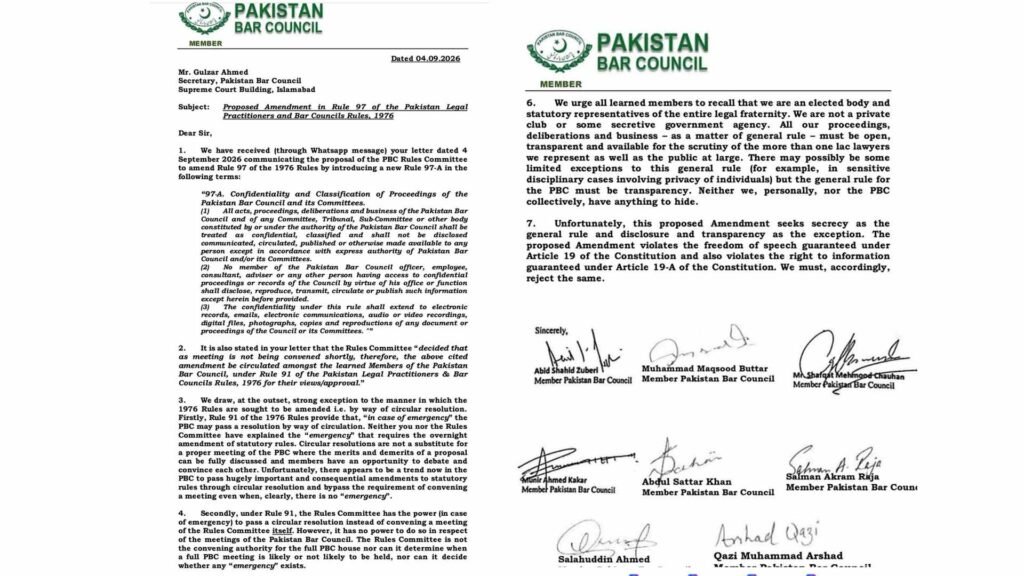
ISLAMABAD: Days after journalist Saddia Mazhar secured a significant Right to Information (RTI) ruling against the Pakistan Bar Council (PBC), eight members of the Council, including prominent lawyer Salman Akram Raja, have strongly opposed a proposed amendment seeking to declare all proceedings, deliberations and business of the PBC and its committees “confidential” and “classified.”
The eight members have questioned both the legality and procedure adopted for the proposed amendment, arguing that the move would make secrecy the general rule in an elected statutory body and could undermine the constitutional right to information guaranteed under Article 19-A of the Constitution.
The development assumes particular significance because it comes in the wake of an order by the Pakistan Information Commission (PIC) on an appeal filed by journalist Saddia Mazhar, in which the Commission declared the Pakistan Bar Council a public body and directed it to provide information sought by her regarding government grants received by the Council.
Mazhar had sought details concerning government grants received by the PBC, along with other information relating to the Council’s affairs. The PIC, after examining the legal status and functions of the PBC, held that it falls within the scope of the Right of Access to Information Act and is consequently subject to obligations of transparency and disclosure.
Against this backdrop, the proposed amendment to the Pakistan Legal Practitioners and Bar Councils Rules, 1976, has triggered a strong reaction from within the Council itself.


Proposed Rule 97-A seeks confidentiality of PBC proceedings
According to a letter addressed to PBC Secretary Gulzar Ahmed, the Rules Committee has proposed inserting a new Rule 97-A into the Pakistan Legal Practitioners and Bar Councils Rules, 1976.
The proposed provision is titled “Confidentiality and Classification of Proceedings of the Pakistan Bar Council and its Committees.”
Under the proposed Rule 97-A, all acts, proceedings, deliberations and business of the Pakistan Bar Council, as well as those of its committees, tribunals, sub-committees and other bodies constituted by or under the authority of the Council, would be treated as confidential and classified.
The proposed rule further provides that such information would not be disclosed, communicated, circulated, published or otherwise made available to any person except with the express authority of the PBC and/or its committees.
The proposed restrictions would also extend to members of the Council, officers, employees, consultants, advisers and other individuals who have access to confidential proceedings or records by virtue of their office or functions.
The proposed rule specifically seeks to cover electronic and digital material, including emails, electronic communications, audio and video recordings, digital files, photographs, copies and reproductions of documents or proceedings.
Eight members challenge circular approval process
In their letter, the eight PBC members have taken strong exception to the manner in which the amendment is being processed.
They said they received, through WhatsApp, a letter dated September 4, 2026, communicating the Rules Committee’s proposal and seeking members’ views or approval through circulation.
According to the communication, the Rules Committee decided to circulate the proposed amendment because a meeting of the PBC was not expected to be convened shortly.
The eight members, however, questioned the invocation of Rule 91 for this purpose.
They pointed out that Rule 91 allows the Council to pass a resolution through circulation “in case of emergency.”
The members asked what emergency existed that required what they described as an “overnight amendment” to statutory rules.
They argued that circular resolutions were never intended to serve as a substitute for properly convened meetings of the PBC, particularly when dealing with amendments that could have significant and far-reaching consequences.
According to the members, important proposals should be discussed in a full meeting where members can examine their merits and demerits, raise objections and attempt to convince their colleagues before a decision is reached.
They further alleged that there appeared to be a growing trend within the PBC of passing “hugely important and consequential amendments” to statutory rules through circular resolutions instead of convening meetings, even in circumstances where no genuine emergency existed.
Rules Committee cannot decide whether full PBC meeting is necessary, members say
The eight members have also challenged the Rules Committee’s authority to use the circular procedure in relation to the full Pakistan Bar Council.
They maintained that while Rule 91 may empower the Rules Committee, in an emergency, to pass a resolution through circulation instead of convening its own meeting, the provision does not confer upon the Rules Committee the authority to bypass a meeting of the full PBC.
According to the members, the Rules Committee is neither the convening authority for the full Council nor empowered to determine when a full PBC meeting is likely to be held.
Nor, they argued, can the Rules Committee itself determine whether an emergency exists that justifies avoiding a meeting of the full Council.
The objection therefore goes beyond the substance of the proposed confidentiality rule and directly challenges the process through which the amendment is being put before members for approval.
‘We are an elected body, not a private club’
The members reminded their colleagues that the Pakistan Bar Council is an elected statutory body representing the legal fraternity and should not operate as a private or secretive organisation.
They argued that the PBC represents more than one hundred thousand lawyers and that its proceedings, deliberations and business should, as a general principle, be open to scrutiny by those it represents as well as the public.
The members acknowledged that there could be limited circumstances in which confidentiality may legitimately be required.
They specifically referred to sensitive disciplinary matters involving the privacy of individuals as a possible example where restrictions could be justified.
However, they maintained that such cases should constitute exceptions rather than the rule.
According to the dissenting members, transparency should be the general rule for the PBC, while confidentiality should be confined to narrowly defined and legally justified circumstances.
They also stated that neither the members individually nor the PBC collectively had anything to hide.
Proposed amendment accused of reversing transparency principle
The members’ central objection is that the proposed Rule 97-A would reverse the normal relationship between secrecy and disclosure.
Instead of identifying specific categories of information that legitimately require confidentiality, the proposed rule would, in their view, classify virtually everything connected with the PBC’s functioning as confidential unless the Council or its committees expressly authorise disclosure.
They argued that this would effectively make secrecy the rule and transparency the exception.
The timing of the proposal has also attracted attention because of the recent PIC proceedings involving Saddia Mazhar.
The PIC’s determination that the PBC is a public body has placed its financial and administrative affairs within a broader framework of public accountability and access to information.
The Commission’s order directing disclosure of information sought by Mazhar has therefore created an important backdrop to the latest internal dispute over confidentiality.
Article 19-A invoked
The eight members have expressly linked their opposition to the proposed amendment with constitutional guarantees.
They contend that the proposed rule violates the freedom of speech guaranteed under Article 19 and the right to information guaranteed under Article 19-A of the Constitution.
Article 19-A provides citizens with the right to have access to information in matters of public importance, subject to regulation and reasonable restrictions imposed by law.
The members’ position is that the PBC, as an elected statutory body performing functions affecting the legal profession and the public, should operate consistently with this constitutional principle.
Their objection also places the proposed rule in direct tension with the transparency principle highlighted by the PIC in the Saddia Mazhar case.
Eight members call for rejection
The letter concludes with a clear call for rejection of the proposed amendment.
The signatories argue that the PBC should not adopt a blanket confidentiality regime covering its proceedings, deliberations and records.
Instead, they favour transparency as the default position, with carefully defined exceptions for genuinely sensitive matters.
The letter has been signed by:
• Abid Shahid Zuberi
• Muhammad Maqsood Buttar
• M. Shafqat Mehmood Chauhan
• Munir Ahmed Kakar
• Abdul Sattar Khan
• Salman Akram Raja
• Salahuddin Ahmed
• Qazi Muhammad Arshad
The intervention by the eight members has opened a new chapter in the controversy surrounding access to information about the Pakistan Bar Council.
What makes the development particularly significant is its timing: the proposed secrecy rule has emerged immediately after Saddia Mazhar’s successful challenge before the Pakistan Information Commission, which resulted in the PBC being recognised as a public body for purposes of access to information.
The dispute now places two competing principles directly before the Council—the confidentiality of internal deliberations on one hand and transparency and public accountability on the other.